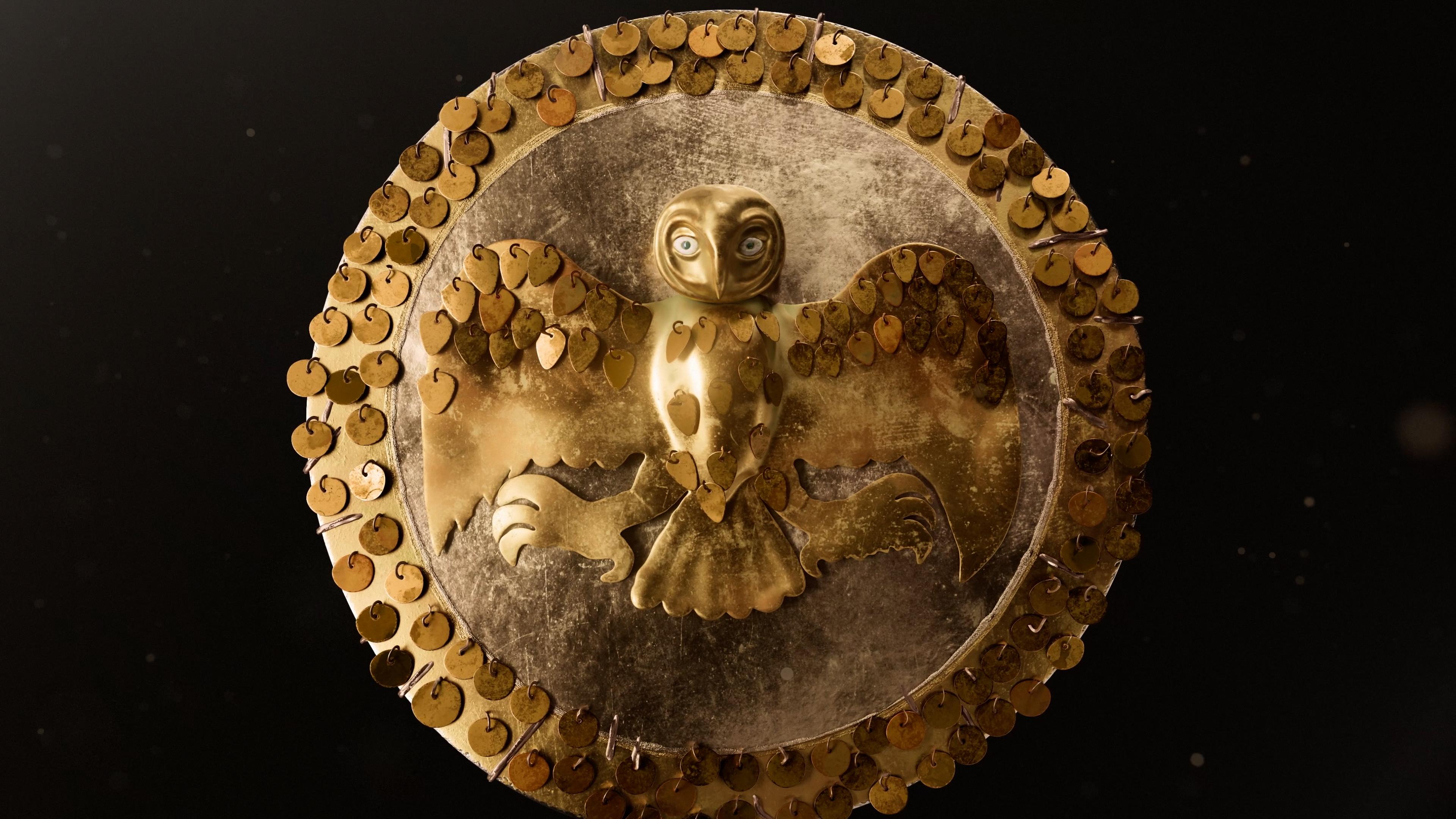
Shield with owl figure
The function of disks such the present example is unclear. They may have served as shield frontals, attached to a cane backing, but the delicate nature of the design would have limited its protective function in actual battle. Thus, these objects may have been intended for ritual use as symbolic weapon adornments. Alternatively, they may have been attached to textile banners or hangings.
The Moche (also known as the Mochicas) flourished on Peru’s North Coast from 200-850 CE, centuries before the rise of the Inca. Over the course of some six centuries, the Moche built thriving regional centers from the Nepeña River Valley in the south to perhaps as far north as the Piura River, near the modern border with Ecuador, developing coastal deserts into rich farmlands and drawing upon the abundant maritime resources of the Pacific Ocean’s Humboldt Current. Although the Moche never formed a single centralized political entity, they shared unifying cultural traits such as religious practices (Donnan, 2010).
This object was said to have been found at the burial site of Loma Negra, which was one of the most northern outposts of Moche culture. Loma Negra works in metal share similar iconography with ceramics and metalwork found at Moche sites father to the south, such as Ucupe (Bourget, 2014). The precise relationship between the Loma Negra and the Moche “heartland” remains a subject of debate, however (Kaulicke, 2006).
As there was no tradition of writing in the Andes before the arrival of Europeans in the sixteenth century, the precise significance of owls in Moche art is unknown. Clearly, the owl was one of the more powerful birds in the Moche bestiary: owls are carnivores and prey on other animals, which may have been of symbolic importance. In addition, the owl’s ability to fly at night may have been seen as indicative of mystical or divine power. In this latter respect, the importance of the owl may be similar to that of the bat, which was also given high status in the pantheon of Moche art.
References
Jones, Julie. “Innovation and Resplendence: Metalwork for Moche Lords.” In Moche Art and Archaeology in Ancient Peru, edited by Joanne Pillsbury. Studies in the History of Art 63. Center for Advanced Study in the Visual Arts, Symposium Papers 15. Washington D.C.: National Gallery of Art, 2001, pp. 206-221. Illustrated on p. 214, fig. 4.
Schorsch, Deborah. "Silver-and-Gold Moche Artifacts from Loma Negra, Peru." Metropolitan Museum Journal vol. 33 (1998).
Further Reading
Bourget, Steve. Les rois mochica: Divinité et pouvoir dans le Pérou ancient. Paris: Somogy éditions d'art; Geneva: MEG, Musée d'ethnographie de Genève, 2014.
Castillo, Luis Jaime. “Masters of the Universe: Moche Artists and Their Patrons.” In Golden Kingdoms: Luxury Arts in the Ancient Americas, edited by Joanne Pillsbury, Timothy Potts, and Kim N. Richter. Los Angeles: J. Paul Getty Museum, 2017, pp. 24-31.
Donnan, Christopher B. “Moche State Religion.” In New Perspectives on Moche Political Organization, edited by Jeffrey Quilter and Luis Jaime Castillo. Washington D.C.: Dumbarton Oaks Research Library and Collection, 2010, pp. 47-69.
Kaulicke, Peter. “The Vicús-Mochica Relationship.” In Andean Archaeology III, edited by William H. Isbell and Helene H. Silverman. Boston, MA: Springer, 2006, pp. 85-111.
Lechtman, Heather, Antonieta Erling, and Edward J. Barry Jr. "New Perspectives on Moche Metallurgy; Techniques of Gilding Copper at Loma Negra, Northern Peru." American Antiquity vol. 47 (1982), pp. 3-30.
Schorsch, Deborah. "Silver-and-Gold Moche Artifacts from Loma Negra, Peru." Metropolitan Museum Journal vol. 33 (1998).
Schorsch, Deborah, Ellen G. Howe, and Mark T. Wypyski, “Silvered and Gilded Copper Metalwork from Loma Negra: Manufacture and Aesthetics.” Boletin Museo del Oro vol.4 (1996), pp. 145-163.
Artwork Details
- Title: Shield with owl figure
- Artist: Moche artist(s)
- Date: 500–800 CE
- Geography: Peru, Piura region
- Culture: Moche
- Medium: Gilded copper, silvered copper, shell, beads, fibers
- Dimensions: H. 10 1/2 × W. 10 1/2 × D. 1 in. (26.7 × 26.7 × 2.5 cm)
- Classification: Metal-Ornaments
- Credit Line: Bequest of Jane Costello Goldberg, from the Collection of Arnold I. Goldberg, 1986
- Object Number: 1987.394.56
- Curatorial Department: The Michael C. Rockefeller Wing
More Artwork
Press the down key to skip to the last item.
Related Content
 Free to download
Research Resources
The Met provides unparalleled resources for research and welcomes an international community of students and scholars. The Met's Open Access API is where creators and researchers can connect to the The Met collection. Open Access data and public domain images are available for unrestricted commercial and noncommercial use without permission or fee.
To request images under copyright and other restrictions, please use this Image Request form.
Feedback
We continue to research and examine historical and cultural context for objects in The Met collection. If you have comments or questions about this object record, please contact us using the form below. The Museum looks forward to receiving your comments.
Content Notice
The Metropolitan Museum of Art presents over 5,000 years of art from around the world, and our online collection reflects ongoing work conducted over the course of our more than 150-year history. You may encounter objects or images that may be inappropriate for some viewers or information that may be outdated.