Processional Cross
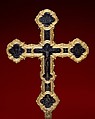
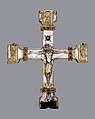
The inscription at the base on the back of the cross identifies it as the votive gift (supplication) of a Bishop Leo. It was probably offered in honor of Saint Thalelaios, a physician, who is shown in the back central medallion with the symbols of his profession, a medical case and the pointed surgical tool known as a lancet. To the sides are saints Nicholas and John Chrysostom, two of the most important early church fathers. The archangels Uriel and Raphael appear at top and bottom. A homily (sermon) attributed to Saint John Chrysostom describes crosses as "power for those who are ill" and "the purification of sickness"; the donation of this cross was perhaps connected to an illness. The cross may have been used in the ceremony for the purification of water, since Thalelaios, a late third-century martyr, is one of the saints named in that service.
Artwork Details
- Title: Processional Cross
- Date: ca. 1000–1050
- Culture: Byzantine
- Medium: Silver with gilding and gilded silver medallions
- Dimensions: Overall: 23 7/16 x 16 15/16 x 7/8 in. (59.5 x 43 x 2.2 cm)
Diameter of central medallion on back: 2 3/8 in. (6 cm)
Diameter of central medallion on front: 2 5/16 in. (5.9 cm)
width of arms: 5 3/16 in. (13.2 cm)
diameter of Michael medallion: 1 3/4 in. (4.4 cm)
diameter of John the Baptist medallion: 1 5/8 in. - Classification: Metalwork-Silver
- Credit Line: Rogers Fund, 1993
- Object Number: 1993.163
- Curatorial Department: Medieval Art and The Cloisters
Audio
2730. Processional Cross, Part 1
Finely wrought silver-gilt medallions decorate both sides of this handsome processional cross. The one in the center-front depicts a bust of Christ. This elegantly chiseled face is typical of Byzantine craftsmanship of the early eleventh century. A pattern of freely worked vine-scrolls adorns each of the four arms, and forms a smaller cross around the bust of Christ.
Medallions at the ends of the crossbar show the Virgin Mary and John the Baptist. Various archangels and saints appear on other medallions. An elegant acanthus leaf decorates the base of the cross, where a staff would have been inserted to carry it in processions.
Look at the back of the cross. The figure in the center is the physician saint Thalelaeus. Thalelaus was one of the anargyroi—miracle-working medical saints who cured people and charged nothing for their services.
Crosses were widely used in religious, military, and imperial processions during the Middle Byzantine era.
Listen to more about this artwork
More Artwork
Press the down key to skip to the last item.
Related Content


Research Resources
The Met provides unparalleled resources for research and welcomes an international community of students and scholars. The Met's Open Access API is where creators and researchers can connect to the The Met collection. Open Access data and public domain images are available for unrestricted commercial and noncommercial use without permission or fee.
To request images under copyright and other restrictions, please use this Image Request form.
Feedback
We continue to research and examine historical and cultural context for objects in The Met collection. If you have comments or questions about this object record, please contact us using the form below. The Museum looks forward to receiving your comments.
Content Notice
The Metropolitan Museum of Art presents over 5,000 years of art from around the world, and our online collection reflects ongoing work conducted over the course of our more than 150-year history. You may encounter objects or images that may be inappropriate for some viewers or information that may be outdated.