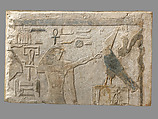
Lintel depicting King Amenemhat I flanked by Nekhbet, Horus, Anubis, and Wadjet
The first king of Dynasty 12, Amenemhat I is known to have been born in the south of Egypt, and may have served as vizier to the last ruler of the previous dynasty, Mentuhotep IV. Early in his reign, he moved the capital from Thebes to a new city in the north, Itj-tawy. In order to ensure the stability of his new dynasty, he also appears to have established a coregency with his son, Senwosret I, ten years before his demise.
This block was found in the foundations of the king's mortuary temple at Lisht, the royal cemetery of the new capital. It was reused from an earlier building that stood either at the same site or somewhere else in the area of Itj-tawy. The low relief carving is delicate, with many details only indicated by the well-preserved paint. In style, it is transitional between the Theban reliefs of Dynasty 11 (see for example 07.230.2) and that of the "Memphite" (northern) school, which would become the classical style of the Middle Kingdom.
Artwork Details
- Title: Lintel depicting King Amenemhat I flanked by Nekhbet, Horus, Anubis, and Wadjet
- Period: Middle Kingdom
- Dynasty: Dynasty 12
- Reign: reign of Amenemhat I–Senwosret I
- Date: ca. 1981–1952 BCE
- Geography: From Egypt, Memphite Region, Lisht North, Pyramid Temple of Amenemhat I, MMA excavations, 1907
- Medium: Limestone, paint
- Dimensions: H. 36.8 × W. 172.7 × D. 13.3 cm, 183.7 kg (14 1/2 × 68 × 5 1/4 in., 405 lb.)
- Credit Line: Rogers Fund, 1908
- Object Number: 08.200.5
- Curatorial Department: Egyptian Art
Audio
3315. Lintel depicting King Amenemhat I flanked by Nekhbet, Horus, Anubis, and Wadjet
NARRATOR: This relief, and the others along the walls of this room, come from a cemetery near a village called Lisht, located about thirty miles south of Cairo. The ancient city associated with this cemetery, now covered by many feet of agricultural land at Lisht, was the capital of Middle Kingdom Egypt. The figure in the center is King Amenemhat I, the first ruler of the Twelfth Dynasty.
From 1906 to 1934, the Museum excavated the cemetery that lies west of Lisht, where this relief was found. It originally belonged to a small temple the king had built in connection with his pyramid. Dorothea Arnold, who is Lila Acheson Wallace Curator in Charge of the Department of Egyptian Art at The Metropolitan Museum of Art, describes the scene.
DOROTHEA ARNOLD: What we have here is the upper part of the depiction of one of the rituals of the Heb Sed, of the thirty years’ jubilee of the king. The king is seen in the middle—you see his head and shoulders. He is actually running. He’s striding with his legs far apart. And that was an important part of the thirty years’ jubilee. If you want to say it in a mundane way, he showed his strength, that he after thirty years could still run. But, of course, you have to take it much more ritually….And of course he needed the help of the gods.
NARRATOR: Some of that help came from Horus, the falcon-headed god to the left of the king. Horus was the god of kingship, so of course he was an important part of the pharaoh’s ritual rejuvenation. To the right of the king, is the jackal-headed deity, Anubis. He is present here in his role of lord of the cemetery, where this relief was originally erected. On the far right and left, you see two female figures. These are the goddesses of Lower and Upper Egypt, Nekhbet and Wadjet, and they represent the presence of the entire country at this ritual.
More Artwork
Press the down key to skip to the last item.
Related Content
Research Resources
The Met provides unparalleled resources for research and welcomes an international community of students and scholars. The Met's Open Access API is where creators and researchers can connect to the The Met collection. Open Access data and public domain images are available for unrestricted commercial and noncommercial use without permission or fee.
To request images under copyright and other restrictions, please use this Image Request form.
Feedback
We continue to research and examine historical and cultural context for objects in The Met collection. If you have comments or questions about this object record, please contact us using the form below. The Museum looks forward to receiving your comments.
Content Notice
The Metropolitan Museum of Art presents over 5,000 years of art from around the world, and our online collection reflects ongoing work conducted over the course of our more than 150-year history. You may encounter objects or images that may be inappropriate for some viewers or information that may be outdated.