Under Roman control, the Iberian Peninsula prospers commercially and politically in the first and second centuries A.D., until the Moors attack from North Africa in the latter part of the second century. The Franks from the middle and lower Rhine regions devastate the Hispanic provinces in the third century. In the aftermath, Diocletian divides the peninsula into six Roman provinces that survive only until the Visigoths establish their kingdom in 409.
Iberian Peninsula, 1–500 A.D.
Timeline
1 A.D.
125 A.D.
Roman rule, ca. 19 B.C.–393 A.D.
Iberian culture, ca. 600 B.C.–200 A.D.
125 A.D.
250 A.D.
Roman rule, ca. 19 B.C.–393 A.D.
Iberian culture, ca. 600 B.C.–200 A.D.
250 A.D.
375 A.D.
Roman rule, ca. 19 B.C.–393 A.D.
375 A.D.
500 A.D.
Roman rule, ca. 19 B.C.–393 A.D.
Kingdom of the Visigoths, ca. 409–711 A.D.
Overview
Key Events
-
68 A.D.
Galba, governor of the Roman province in northern Spain, declares himself emperor but reigns only a few months.
-
ca. 70 A.D.
The Roman emperor Vespasian grants Latin rights to all Spanish communities. Towns prosper under the new charters.
-
98 A.D.
Trajan, born at Italica in southern Spain, becomes Roman emperor. In 117 A.D., he is succeeded by Hadrian, another Spaniard. They are the first Romans from outside Italy to gain the imperial purple.
-
276 A.D.
The Franks from the middle and lower Rhine regions launch intermittent attacks on northern Spain. Eventually, the peninsula, with the Balearic Islands and the Tingitana region, is divided into six provinces by Diocletian.
-
early 4th century A.D.
A powerful church emerges at the Council of Iliberis (near modern-day Granada), and Hosius, bishop of Corduba (Córdoba), confirms its influence. It inspires the work of Prudentius in the late fourth century and survives the barbarian invasions of the fifth century.
-
711 A.D.
The Moors from northern Africa invade Spain.
Citation
“Iberian Peninsula, 1–500 A.D.” In Heilbrunn Timeline of Art History. New York: The Metropolitan Museum of Art, 2000–. http://www.metmuseum.org/toah/ht/?period=05®ion=eusi (October 2000)
Related
Map
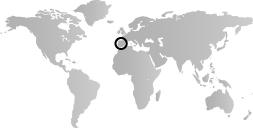
Encompasses present-day Portugal and Spain