Stieglitz and His Artists
Results per page
  • 6
30 77b122f9-d792-4627-a9d0-d00cea59325d
210008683
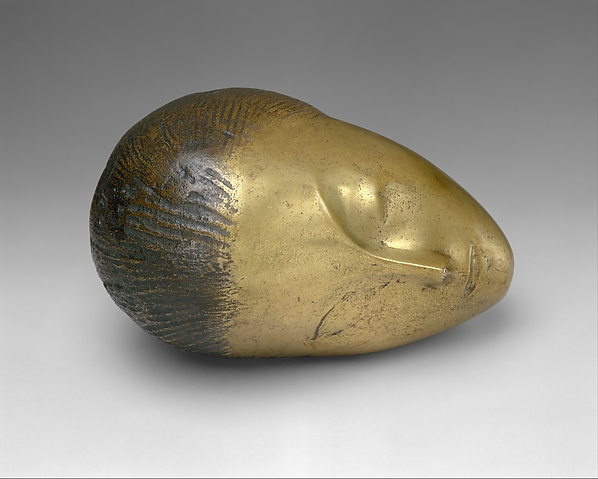
Sleeping Muse

Sleeping Muse

Constantin Brancusi (French (born Romania), Hobita 1876–1957 Paris)

Date:
1910
Medium:
Bronze
Dimensions:
6 3/4 x 9 1/2 x 6 in. (17.1 x 24.1 x 15.2 cm) Weight: 12 lbs
Classification:
Sculpture
Credit Line:
Alfred Stieglitz Collection, 1949
Accession Number:
49.70.225
Rights and Reproduction:
© 2011 Artists Rights Society (ARS), New York

Description

Here, the languor of the ovoid shape responding to gravity suggests the heaviness of sleep. The sleeping head, one of Brancusi's first thematic cycles, occupied the artist for almost twenty years. This bronze is one of four cast in 1910 from a marble of the previous year for which Baroness Renée Irana Franchon was the model.

210008543
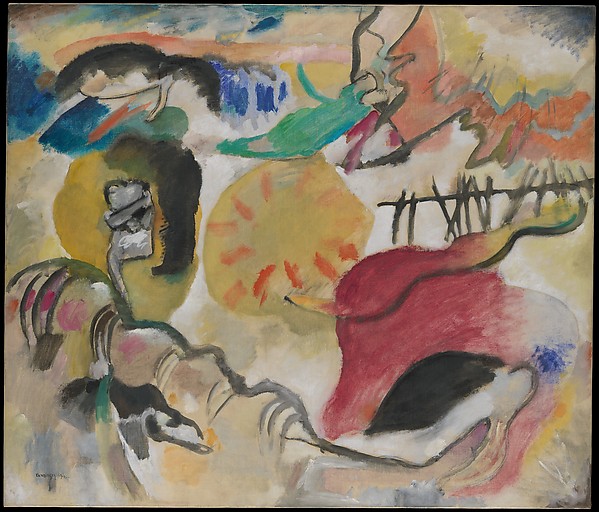
Improvisation 27 (Garden of Love II)

Improvisation 27 (Garden of Love II)

Vasily Kandinsky (French, (born Russia) Moscow 1866–1944 Neuilly-sur-Seine)

Date:
1912
Medium:
Oil on canvas
Dimensions:
47 3/8 x 55 1/4 in. (120.3 x 140.3 cm)
Classification:
Paintings
Credit Line:
Alfred Stieglitz Collection, 1949
Accession Number:
49.70.1
Rights and Reproduction:
© 2011 Artists Rights Society (ARS), New York

Description

Russian artist Wassily Kandinsky moved to Munich to study painting in 1896. There, he became one of the founding members of Der Blaue Reiter (The Blue Rider), a loose association of artists formed in 1911 to promote a new art, one that would reject the materialist world in favor of the world of emotion and the spirit. The following year, when the artist painted "The Garden of Love," he also published his influential book, ¦On the Spiritual in Art¦. In accordance with his belief in the primacy of the inner, spiritual world, Kandinsky's art was abstract, meant to be expressive of our preconscious selves, before the intervention of reason. By dematerializing the external appearance of his subject, without eliminating all visual reference to it, he could reveal the subject's essence. Kandinsky often used musical terminology to describe his work. The "improvisation" in the subtitle of this painting suggests "a largely unconscious, spontaneous expression of inner character, the non-material nature."

The specific source for the imagery in "The Garden of Love" is most likely the biblical story of Paradise and the Garden of Eden, one of several Old and New Testament themes addressed by the artist. The imaginary landscape revolves around a large yellow sun in the center of the composition, which pulses with rays of red. The garden is occupied by three abstract pairs of embracing figures: a reclining couple above the sun, another at the lower right, and a third, smaller pair seated at the left. Surrounding them are several animals—certainly a snake and perhaps a grazing horse and a sleeping dog. Kandinsky, who was a master of watercolor, successfully achieved similar effects in his oil paintings. Here, large areas of bright, transparent color fill the space amorphously, their fluid motion fixed by various linear accents painted in black that represent the ground, a fence, and dark patches of rain.

210008680
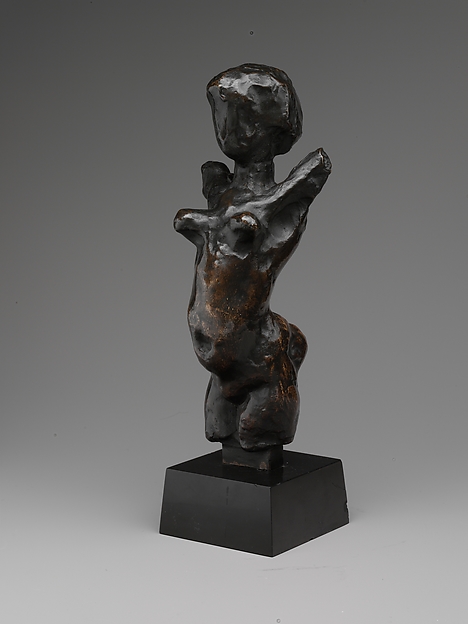
Female Torso

Female Torso

Henri Matisse (French, Le Cateau-Cambrésis 1869–1954 Nice)

Date:
1906; cast ca. 1908
Medium:
Bronze, 2/10
Dimensions:
9 1/8 x 4 x 3 in.,(23.2 x 10.2 x 7.6 cm) Weight 5 lbs
Classification:
Sculpture
Credit Line:
Alfred Stieglitz Collection, 1949
Accession Number:
49.70.222
Rights and Reproduction:
© 2011 Succession H. Matisse / Artists Rights Society (ARS), New York
210008752
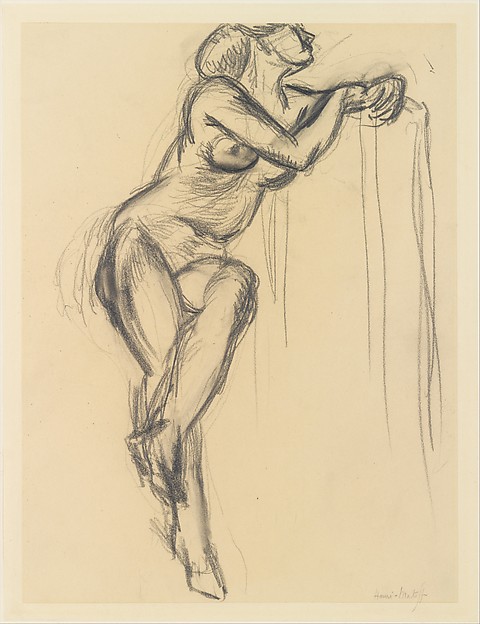
Nude

Nude

Henri Matisse (French, Le Cateau-Cambrésis 1869–1954 Nice)

Date:
ca. 1908
Medium:
Graphite on paper
Dimensions:
12 x 9 1/8 in. (30.5 x 23.2 cm)
Classification:
Drawings & Watercolors
Credit Line:
Alfred Stieglitz Collection, 1949
Accession Number:
49.70.8
Rights and Reproduction:
© 2011 Succession H. Matisse / Artists Rights Society (ARS), New York
210008588
Here, This Is Stieglitz Here

Here, This Is Stieglitz Here

Francis Picabia (French, Paris 1879–1953 Paris)

Date:
1915
Medium:
Ink, graphite, and cut-and-pasted painted and printed papers on paperboard
Dimensions:
29 7/8 x 20 in. (75.9 x 50.8 cm)
Classification:
Drawings & Watercolors
Credit Line:
Alfred Stieglitz Collection, 1949
Accession Number:
49.70.14
Rights and Reproduction:
© 2011 Artists Rights Society (ARS), New York

Description

Francis Picabia created Here, This Is Stieglitz Here (Ici, c'est Stieglitz) in 1915, after having relocated to New York from Paris earlier that year. While in New York, the Cubist painter met the American photographer Alfred Stieglitz, who would later organize an exhibition of Picabia's works at his legendary gallery 291 and collaborate with him on the Dada publication 291 in which Here first appeared. In this portrait, Picabia is clearly referencing Duchamp's machinist aesthetic as well as his ironic wit. Part of a series of machine portraits of his artist-friends in New York, Here depicts Stieglitz as a broken bellows camera with an automobile brake attached to it that is in motion. It is important to underscore that this series of machine portraits did not celebrate the hyper-mechanized culture of the early twentieth century. Machinist imagery formed a vocabulary that Picabia drew upon in order to capture the modern human spirit. His work is not a comment on the frenzied fascination with which contemporary culture viewed the machine but, rather, a demonstration of how such mechanized symbols can successfully articulate the seemingly opposed values of an individual's sensibility. Picabia has written "Ideal" in an old-fashioned, delicate, highly detailed script that effectively contrasts with the modern-day, sleek machine upon which it perches. The elaborate Gothic font hearkens back to an outdated mode of portraiture and, generally speaking, of painting, against which Picabia is clearly working. More importantly, it addresses Stieglitz's own idealism that, according to those in his circle, had failed to inspire Americans toward self-discovery through art and photography. Indeed, Stieglitz's goal was too grandiose, hence the lofty placement of "Ideal" above the mass-produced object-an object that connotes a commercially driven reality more characteristic of America at this moment in history. Spearheading the effort to introduce the dominant artistic practices of Europe to American artists, Here embraces the humor with which Picabia and Duchamp mocked traditional artistic styles and techniques, and that would characterize their proto-Dada practices during the time they lived in New York.

210008702
Standing Female Nude

Standing Female Nude

Pablo Picasso (Spanish, Malaga 1881–1973 Mougins, France)

Date:
1910
Medium:
Charcoal on paper
Dimensions:
19 x 12 3/8 in. (48.3 x 31.4 cm) 28 3/4 x 22 3/4 x 1 3/4 in. (73 x 57.8 x 4.4 cm) (Frame)
Classification:
Drawings & Watercolors
Credit Line:
Alfred Stieglitz Collection, 1949
Accession Number:
49.70.34
Rights and Reproduction:
© 2011 Estate of Pablo Picasso / Artists Rights Society (ARS), New York

Description

In March 1911, Alfred Stieglitz's small gallery in New York, 291, opened a large exhibition of forty-nine drawings and watercolors by Pablo Picasso, the artist's first showing anywhere in America. Among the highlights in the show, which surveyed the development of his art up to Analytic Cubism (1906-11), was this highly abstract charcoal drawing of a standing female nude, one of several studies on this theme he produced in the spring of 1910. It was, no doubt, one of the most radical drawings in the show and its linear, lattice-like construction prompted the press to derogatively call it "the fire escape." Although reduced to a series of lines and semicircles, without any semblance of three-dimensional form (despite areas of considerable shading), the essential parts of a human body-head, neck, shoulders, arms, torso, breasts, legs, and kneecaps-are all there. The controversy caused by this drawing was incitement enough for Stieglitz to purchase the work for his collection as a representation of the new direction of modern art. In 1913, he lent it to the large international exhibition of modern art in New York known as the Armory Show, where it was overshadowed by the uproar surrounding Duchamp's Nude Descending a Staircase.

<p>Please enable flash to view this media. <a href="http://get.adobe.com/flashplayer/">Download the flash player.</a></p>

Please enable flash to view this media. Download the flash player.

Stieglitz and the New York Art Scene

Program information

This Sunday at the Met program discusses Alfred Stieglitz and the New York Art Scene between 1905 and 1946.

Recorded on October 23, 2011, in conjunction with the exhibition Stieglitz and His Artists: Matisse to O'Keeffe, on view October 13, 2011, through January 2, 2012.

The exhibition is made possible by the Iris & B. Gerald Cantor Foundation.
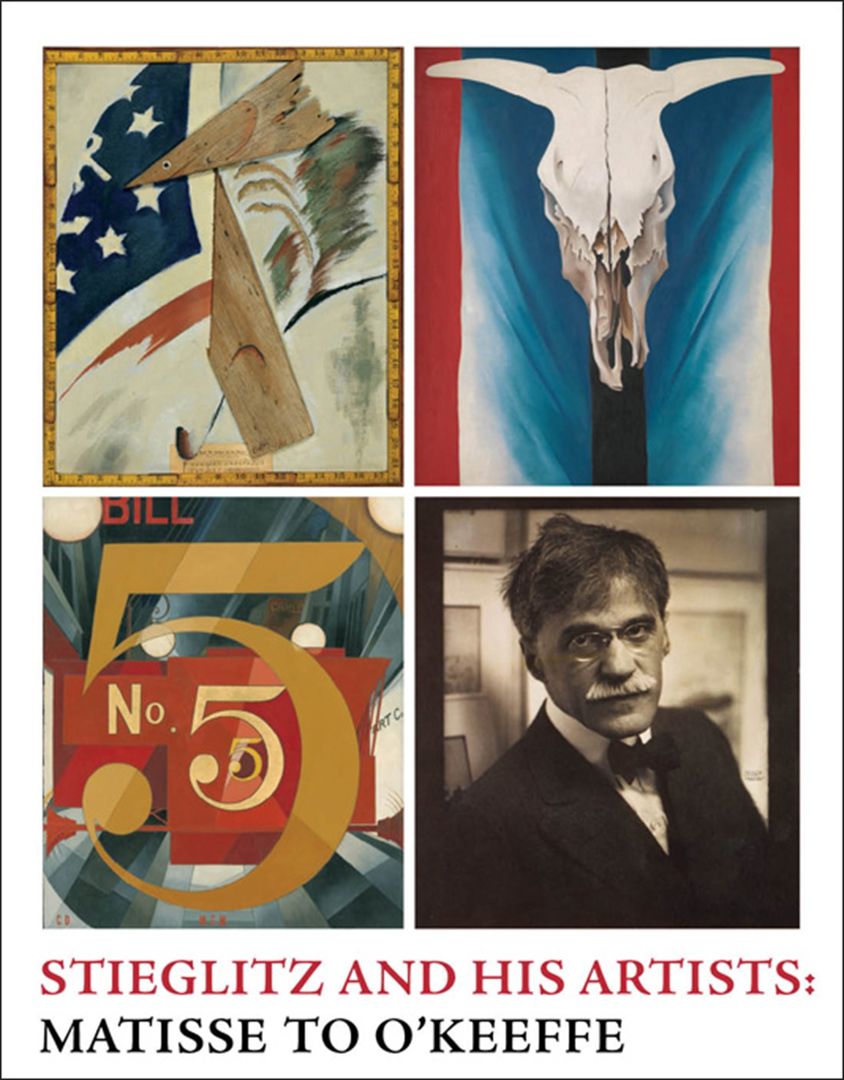
Stieglitz and His Artists: Matisse to O'Keeffe

October 13, 2011–January 2, 2012

Accompanied by a catalogue and an Audio Guide

This exhibition is the first large-scale presentation of paintings, sculptures, drawings, and prints from Alfred Stieglitz's collection, acquired by the Metropolitan in 1949. In addition to being a master photographer, Stieglitz (1864–1946) was a visionary promoter of modern American and European art, and he assembled a vast art collection of exceptional breadth and depth. Through a succession of influential galleries that he ran in New York City between 1905 and 1946, Stieglitz exhibited many of the most important artists of the era, and he collected works by Pablo Picasso, Henri Matisse, Constantin Brancusi, Gino Severini, Vasily Kandinsky, Georgia O'Keeffe, Marsden Hartley, John Marin, Charles Demuth, and Arthur Dove. For more than sixty years, the Alfred Stieglitz Collection has been the cornerstone of the Museum's holdings of modern American art.

The exhibition features some two hundred major works by American and European modernists, supplemented by photographs by the Photo-Secessionists and publications by Stieglitz—all from the Metropolitan's holdings. Highlights include Picasso's Woman Ironing and Standing Female Nude, Kandinsky's Improvisation 27 (Garden of Love II), Brancusi's Sleeping Muse, O'Keeffe's Black Iris and Cow's Skull: Red, White, and Blue, Demuth's I Saw the Figure 5 in Gold, and Hartley's Portrait of a German Officer.

210008683

Close