Lisbon's Hebrew Bible: Medieval Jewish Art in Context
Results per page
  • 6
  • Hebrew Bible: Artist’s Colophon and Arms of Castile-León (fols. 448v-449)

    Hebrew Bible: Artist’s Colophon and Arms of Castile-León (fols. 448v-449)
    Illuminated by Joseph the Frenchman

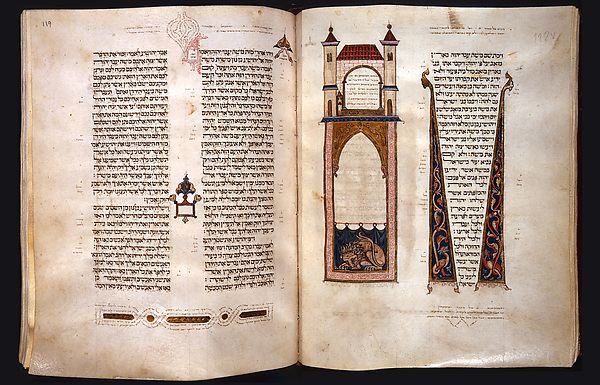
  • Hebrew Bible: Conclusion of Deuteronomy with Lion (fol. 118v-119)

    Hebrew Bible: Conclusion of Deuteronomy with Lion (fol. 118v-119)
    Illuminated by Joseph the Frenchman

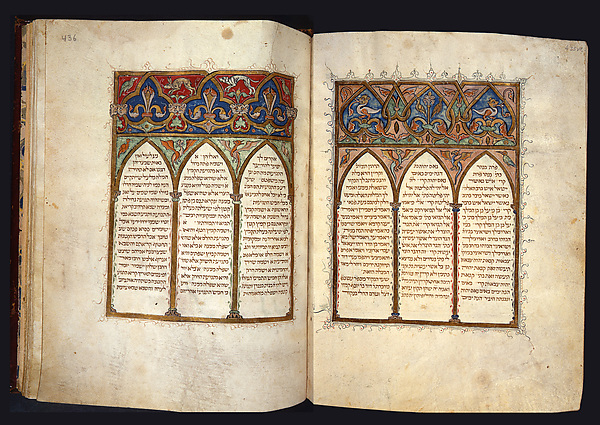
  • Hebrew Bible: Gothic Arches with Dog and Hare (fol. 435v-436)

    Hebrew Bible: Gothic Arches with Dog and Hare (fol. 435v-436)
    Illuminated by Joseph the Frenchman

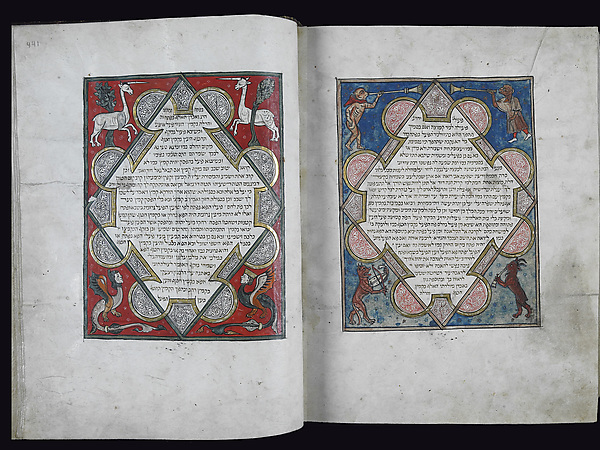
  • Hebrew Bible: Unicorns and Other Creatures (fols. 440v-441)

    Hebrew Bible: Unicorns and Other Creatures (fols. 440v-441)
    Illuminated by Joseph the Frenchman

  • Hebrew Bible: Menorah of Zechariah's Vision (fols. 316v-317)

    Hebrew Bible: Menorah of Zechariah's Vision (fols. 316v-317)
    Illuminated by Joseph the Frenchman

  • Hebrew Bible: Centaurs, Mermen and Other Creatures (fols. 442v-443)

    Hebrew Bible: Centaurs, Mermen and Other Creatures (fols. 442v-443)
    Illuminated by Joseph the Frenchman

8 4a8aa21b-650c-4275-84e5-efec662b65a0
170021868
Hebrew Bible: Artist’s Colophon and Arms of Castile-León (fols. 448v-449)

Hebrew Bible: Artist’s Colophon and Arms of Castile-León (fols. 448v-449)

Illuminated by Joseph the Frenchman

Date:
1299–1300
Geography:
Made in, Spain
Medium:
Tempera, gold, and ink on parchment
Dimensions:
Overall: 11 7/16 x 8 7/8 x 3 15/16 in., 9.464lb. (29 x 22.5 x 10 cm, 4.293kg)
Classification:
Manuscripts & Illuminations
Credit Line:
Biblioteca Nacional de Portugal, Lisbon (BNP, IL.72)

Description

Few medieval manuscripts mention the name of the artist responsible for their decoration, but this bible devotes an entire page to the signature of the illuminator. Playfully transforming the Hebrew letters into images of intertwined animals, he writes, "I, Joseph the Frenchman, illustrated and completed this book."
The right-hand page, which concludes the grammatical compendium that accompanies the sacred text, displays a pair of six-pointed stars enclosing a lion and a castle—the respective symbols of the northern Spanish kingdoms of Leon and Castile, where the patron may have lived.

170021895
Hebrew Bible: Conclusion of Deuteronomy with Lion (fol. 118v-119)

Hebrew Bible: Conclusion of Deuteronomy with Lion (fol. 118v-119)

Illuminated by Joseph the Frenchman

Date:
1299–1300
Geography:
Made in, Spain
Medium:
Tempera, gold, and ink on parchment
Dimensions:
Overall: 11 7/16 x 8 7/8 x 3 15/16 in., 9.464lb. (29 x 22.5 x 10 cm, 4.293kg)
Classification:
Manuscripts & Illuminations
Credit Line:
Biblioteca Nacional de Portugal, Lisbon (BNP, IL.72)

Description

Most of the decoration in this bible appears in the tracts devoted to Hebrew vocalization and grammar that precede and follow the biblical text. One exception appears after the first five books of the bible that comprise the Torah. Here, the text on the right-hand page represents the final paragraph of Deuteronomy. A tower, in which sleeps a lion, provides a visual pause before proceeding to the rest of the text, which is read from right to left. Lions were a favored device in both Jewish and Christian art. In a Jewish context, they often served as a symbol of the Israelite tribe of Judah.
The tiny writing in the margins is part of the masorah, commentary that notes textual details such as the precise spelling of words. It was written by a specialist scribe, Joshua ibn Gaon, who embedded his name some twenty times within his text.

170021896
Hebrew Bible: Gothic Arches with Dog and Hare (fol. 435v-436)

Hebrew Bible: Gothic Arches with Dog and Hare (fol. 435v-436)

Illuminated by Joseph the Frenchman

Date:
1299–1300
Geography:
Made in, Spain
Medium:
Tempera, gold, and ink on parchment
Dimensions:
Overall: 11 7/16 x 8 7/8 x 3 15/16 in., 9.464lb. (29 x 22.5 x 10 cm, 4.293kg)
Classification:
Manuscripts & Illuminations
Credit Line:
Biblioteca Nacional de Portugal, Lisbon (BNP, IL.72)

Description

This bible concludes with a compendium of Hebrew grammar, where some of the most inventive decoration in the book resides. Each double-page spread provided the artist, Joseph the Frenchman, with an opportunity to experiment with elaborate framing devices. Here, as in many Christian manuscripts, he used an arcade decorated with colors and motifs found in contemporary enamels and manuscripts.

170021897
Hebrew Bible: Unicorns and Other Creatures (fols. 440v-441)

Hebrew Bible: Unicorns and Other Creatures (fols. 440v-441)

Illuminated by Joseph the Frenchman

Date:
1299–1300
Geography:
Made in, Spain
Medium:
Tempera, gold, and ink on parchment
Dimensions:
Overall: 11 7/16 x 8 7/8 x 3 15/16 in., 9.464lb. (29 x 22.5 x 10 cm, 4.293kg)
Classification:
Manuscripts & Illuminations
Credit Line:
Biblioteca Nacional de Portugal, Lisbon (BNP, IL.72)

Description

This bible concludes with a compendium of Hebrew grammar, where some of the most inventive decoration in the book resides. Each double-page spread of the supplementary text provided the artist, Joseph the Frenchman, with an opportunity to experiment with elaborate framing devices. This particularly fanciful example depicts not only apes and goats playing musical instruments but also unicorns and harpies cavorting in the brightly colored margins.

170021898
Hebrew Bible: Menorah of Zechariah's Vision (fols. 316v-317)

Hebrew Bible: Menorah of Zechariah's Vision (fols. 316v-317)

Illuminated by Joseph the Frenchman

Date:
1299–1300
Geography:
Made in, Spain
Medium:
Tempera, gold, and ink on parchment
Dimensions:
Overall: 11 7/16 x 8 7/8 x 3 15/16 in., 9.464lb. (29 x 22.5 x 10 cm, 4.293kg)
Classification:
Manuscripts & Illuminations
Credit Line:
Biblioteca Nacional de Portugal, Lisbon (BNP, IL.72)

Description

Most of the decoration in this bible appears in the supplementary texts that precede and follow the sacred text. A notable exception is this full-page image of a menorah fueled by oil flowing directly from two fruit-laden olive trees. It illustrates the prophet Zechariah’s vision of a golden candlestick with seven lamps flanked by olive trees that feed the lamps through two golden tubes. Medieval Jewish commentators interpreted the passage as a messianic vision evoking the longed-for moment when the Temple will be rebuilt—just as the olives were pressed into oil for the lamps without human intervention, so too will the Temple be rebuilt by the spirit of God. The golden menorah was also understood as a metaphor for the Jewish people, who serve as a shining lamp among nations.

170021899
Hebrew Bible: Centaurs, Mermen and Other Creatures (fols. 442v-443)

Hebrew Bible: Centaurs, Mermen and Other Creatures (fols. 442v-443)

Illuminated by Joseph the Frenchman

Date:
1299–1300
Geography:
Made in, Spain
Medium:
Tempera, gold, and ink on parchment
Dimensions:
Overall: 11 7/16 x 8 7/8 x 3 15/16 in., 9.464lb. (29 x 22.5 x 10 cm, 4.293kg)
Classification:
Manuscripts & Illuminations
Credit Line:
Biblioteca Nacional de Portugal, Lisbon (BNP, IL.72)

Description

Some of the most inventive decoration in this bible resides in the compendium of Hebrew grammar included at the back of the book. Each double-page spread of the supplementary text provided the artist, Joseph the Frenchman, with an opportunity to experiment with elaborate framing devices. Here, the text is enclosed within an interlocking geometric form, while an array of creatures—from centaurs to hens and chicks—inhabits the margins.

This series is made possible by The David Berg Foundation.
Lisbon's Hebrew Bible

Medieval Jewish Art in Context

November 22, 2011–January 16, 2012

All of the images from the Bible are available on the National Library of Portugal website.

The second in a series of installations that focus, one at a time, on masterworks of Hebrew manuscript illumination from a national or international collection. The display highlights Jewish artistic culture in the Middle Ages by presenting it alongside contemporary works of art, mostly created for Christians, from the Museum's own collection. This installment features the Cervera Bible, a designated National Treasure from the National Library of Portugal in Lisbon. The pages of this Hebrew Bible, one of the most splendid manuscripts of the Middle Ages, will be turned weekly, giving viewers the rare opportunity to see many of its beautiful illustrations.

Related article: "Lisbon's Hebrew Bible: An Enlightened Acquisition" (January 9, 2012)


Left: Menorah of Zechariah's Vision (Folio 316v), from the Cervera Bible, illuminated by Joseph the Frenchman, Spain, 1299–1300. Tempera, gold, and ink on parchment. Biblioteca Nacional de Portugal, Lisbon (BNP, IL.72)

170021868

Close