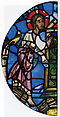
Tree of Jesse Window: The Reclining Jesse, King David, and Scenes from the Life of Jesus
Artwork Details
- Title: Tree of Jesse Window: The Reclining Jesse, King David, and Scenes from the Life of Jesus
- Date: 1280–1300
- Geography: Made in Swabia, Germany
- Culture: German
- Medium: Pot-metal glass, vitreous paint, and lead
- Dimensions: Overall: 154 1/4 x 14 3/4 x 1/2 in. (391.8 x 37.5 x 1.3 cm)
panel a (Jesse): 24 x 14 in. (61 x 35.6 cm)
panel b (David): 25 1/4 x 14 in. (64.1 x 35.6 cm)
panel c (Presentation in the Temple): 25 1/4 x 13 3/4 in. (64.1 x 34.9 cm)
panel d (Last Supper): 25 3/8 x 14 in. (64.5 x 35.6 cm)
panel e (Crucifixion): 25 3/8 x 13 3/4 in. (64.5 x 34.9 cm)
panel f (Ascension): 26 3/4 x 13 3/4 in. (67.9 x 34.9 cm) - Classification: Glass-Stained
- Credit Line: Frederick C. Hewitt Fund, 1922
- Object Number: 22.25a–f
- Curatorial Department: Medieval Art and The Cloisters
Audio
2980. Tree of Jesse Window
NARRATOR: The space you are in right now features stained glass windows and sculpture from the soaring cathedrals of the Gothic Age. Many other fine Gothic stained glass windows can be found at the Cloisters—a branch of the Metropolitan located in Northern Manhattan and dedicated exclusively to Medieval Art. Curator Timothy Husband.
TIMOTHY HUSBAND: Gothic architecture basically tried to dematerialize the vessel of the building itself. The walls become higher and higher, the walls become thinner and thinner. They become so thin, the internal column support so tall and so slender, that the outward thrust can only be held up by external buttressing. And hence you have in high Gothic cathedrals the extraordinary ‘flying buttresses.’ As the Gothic architect became more and more accomplished at his art and engineering the windows became likewise taller and the walls almost dematerialized.
The Gothic cathedral was viewed as God’s house on earth, and the more vertical its appearance, reaching for the heavens above, the more appropriate it seemed as a house of worship, for the greater glory of God. The stained glass had metaphorical meaning as well. For example, the fact that light can pass through glass without physically harming it was equated with the Immaculate Conception and the birth of Christ from a Virgin mother.
More Artwork
Related Content
 Free to download
Research Resources
The Met provides unparalleled resources for research and welcomes an international community of students and scholars. The Met's Open Access API is where creators and researchers can connect to the The Met collection. Open Access data and public domain images are available for unrestricted commercial and noncommercial use without permission or fee.
To request images under copyright and other restrictions, please use this Image Request form.
Feedback
We continue to research and examine historical and cultural context for objects in The Met collection. If you have comments or questions about this object record, please contact us using the form below. The Museum looks forward to receiving your comments.
Content Notice
The Metropolitan Museum of Art presents over 5,000 years of art from around the world, and our online collection reflects ongoing work conducted over the course of our more than 150-year history. You may encounter objects or images that may be inappropriate for some viewers or information that may be outdated.