Crossbow Brooch
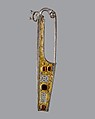
The point of the pin is inserted into a socket in the brooch's foot, and the looped pinhead fits into a perforation at the back center of the head. The pinhead is released by unscrewing the left hexagonal terminal. Because of its sophistication as a mechanism, the screw became a status symbol in jewelry.
Artwork Details
- Title: Crossbow Brooch
- Date: ca. 430
- Geography: Made in Rome/Constantinople
- Culture: Late Roman or Byzantine
- Medium: Gold
- Dimensions: Overall: 4 11/16 x 2 3/16 x 1 9/16 in. (11.9 x 5.5 x 4 cm)
- Classification: Metalwork-Gold
- Credit Line: Purchase, Lila Acheson Wallace Gift, 1995
- Object Number: 1995.97
- Curatorial Department: Medieval Art and The Cloisters
Audio
2800. Crossbow Brooch
Byzantine emperors gave gold crossbow fibulas to soldiers, state officials, and allied chieftains and kings as signs of imperial friendship. This elaborate safety-pin was used to secure the official cloaks of state and military officers. The pin of the fibula is released by unscrewing the onion-shaped terminal to the right. Most fibulae use a simple catch-plate to fasten the pin. The novelty and relative complexity of the screw mechanism made this piece an even more valuable gift.
A Latin cross embedded in a lacey pattern decorates this fibula. It is made with an open-work technique in which the designs are punched into gold sheet to create tiny perforations. The head of the cross represents the imperial Christian monogram, Chi Rho—or the first letters of Christ's name in Greek. Alpha and omega, the first and last letters in the Greek alphabet, are suspended from the arms of the cross, symbolizing the all-encompassing nature of God. The presence of Christian symbolism here probably doesn’t represent an attempt to evangelize the barbarians, many of whom were already Christian. Rather, the recipient would have seen the cross as a symbol of the power of the empire.
More Artwork
Related Content

Research Resources
The Met provides unparalleled resources for research and welcomes an international community of students and scholars. The Met's Open Access API is where creators and researchers can connect to the The Met collection. Open Access data and public domain images are available for unrestricted commercial and noncommercial use without permission or fee.
To request images under copyright and other restrictions, please use this Image Request form.
Feedback
We continue to research and examine historical and cultural context for objects in The Met collection. If you have comments or questions about this object record, please contact us using the form below. The Museum looks forward to receiving your comments.
Content Notice
The Metropolitan Museum of Art presents over 5,000 years of art from around the world, and our online collection reflects ongoing work conducted over the course of our more than 150-year history. You may encounter objects or images that may be inappropriate for some viewers or information that may be outdated.