Tea Urn
Artwork Details
- Title: Tea Urn
- Maker: Paul Revere Jr. (American, Boston, Massachusetts 1734–1818 Boston, Massachusetts)
- Date: 1791
- Geography: Made in Boston, Massachusetts, United States
- Culture: American
- Medium: Silver, ivory
- Dimensions: Overall: 22 1/4 x 10 5/8 x 10 3/8 in. (56.5 x 27 x 26.4 cm); 110 oz. 10 dwt. (3437.2 g)
Body: H. 17 15/16 in. (45.6 cm); 88 oz. 9 dwt. (2750.9 g)
Cover: 7 in. (17.8 cm); Diam. 6 in. (15.2 cm); 11 oz. 5 dwt. (350.7 g)
Insert: H. 9 13/16 in. (24.9 cm); 10 oz. 15 dwt. (335.6 g) - Credit Line: Purchase, The Annenberg Foundation Gift, Annette de la Renta, Mr. and Mrs. Robert G. Goelet, Drue Heinz, and Henry R. Kravis Foundation Inc. Gifts, Friends of the American Wing Fund, Margaret Dewar Stearns Bequest, Mr. and Mrs. Anthony L. Geller and Herbert and Jeanine Coyne Foundation Gifts, Max H. Gluck Foundation Inc. Gift, in honor of Virginia and Leonard Marx, and Rogers, Louis V. Bell and Dodge Funds; and Gift of Elizabeth K. Rodiger, 1990
- Object Number: 1990.226a–d
- Curatorial Department: The American Wing
Audio
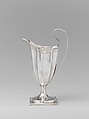
4519. Tea Urn
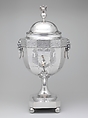
MORRISON HECKSCHER: Colonial Americans quickly adopted the taste for imported coffee, tea and chocolate. These three exotic beverages had been virtually unknown in Europe before the seventeenth century. And the fashionable utensils used in their preparation – such as this monumental hot water urn – became essential as well. Engraved in interlaced script on each side of the urn are the initials “HR.” Hannah Rowe, a wealthy Boston widow, commissioned the urn from Paul Revere. Curator Beth Wees.
BETH WEES: And this is the Paul Revere . . . whom we also know from his midnight ride. He was a wonderful silversmith in Boston, an important silversmith. . . . And the urn actually appears in Paul Revere's business ledgers on the date of April 20th, 1791.
MORRISON HECKSCHER: Shaped like an antique vessel, the work epitomizes the neoclassical style that flourished in America in the late eighteenth- and early nineteenth centuries.
BETH WEES: This wonderful, severe, elegant form, with its attenuated loop handles and the plinth and the very tall cover, reminds us that the young American republic was very much basing itself on ancient Rome. And this form allowed allusions to the glory of ancient Rome.
More Artwork
Press the down key to skip to the last item.
Related Content

 Free to download
Research Resources
The Met provides unparalleled resources for research and welcomes an international community of students and scholars. The Met's Open Access API is where creators and researchers can connect to the The Met collection. Open Access data and public domain images are available for unrestricted commercial and noncommercial use without permission or fee.
To request images under copyright and other restrictions, please use this Image Request form.
Feedback
We continue to research and examine historical and cultural context for objects in The Met collection. If you have comments or questions about this object record, please contact us using the form below. The Museum looks forward to receiving your comments.
Content Notice
The Metropolitan Museum of Art presents over 5,000 years of art from around the world, and our online collection reflects ongoing work conducted over the course of our more than 150-year history. You may encounter objects or images that may be inappropriate for some viewers or information that may be outdated.