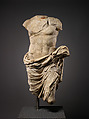
Marble statue of Eirene (the personification of peace)
Eirene, the daughter of Zeus and Themis, was one of the three Horai (Seasons), maidens closely associated with the fertility of the earth and the nurturing of children. The original bronze was erected in the Agora (marketplace) of Athens between 375/374 and 360/359 B.C. Rarely can an ancient monument be dated so exactly. We know from literary sources that the cult of Eirene was introduced to Athens in 375/374, and six recently found Panathenaic amphorae dated to 360/359 show an image of the statue. The Greek traveler Pausanius saw the work in the Agora in the second century A.D. and reported that it was by the sculptor Kephisodotos. Eirene was represented as a beautiful young woman wearing a peplos and himation (cloak), holding a scepter in her right hand, and carrying the young child Ploutos (the personification of wealth) and a cornucopia on her left arm. The figure brings to mind images of Demeter, the major goddess of agricultural plenty and the mother of Ploutos.
Artwork Details
- Title: Marble statue of Eirene (the personification of peace)
- Artist: Roman copy of Greek original by Kephisodotos
- Period: Early Imperial, Julio-Claudian
- Date: ca. 14–68 CE
- Culture: Roman
- Medium: Marble, Pentelic ?
- Dimensions: H. without plinth 69 3/4 in. (177.2 cm)
- Classification: Stone Sculpture
- Credit Line: Rogers Fund, 1906
- Object Number: 06.311
- Curatorial Department: Greek and Roman Art
Audio
- Marble statue of Eirene (the personification of
peace)
This is one of many Roman replicas of a famous Greek bronze group made in the fourth century BC. The statue represents Eirene, the personification of Peace. The original Eirene stood at Athens in the Agora, marketplace and heart of the city. Ancient writers tell us that the original group was made by Kephisodotos, the father of the famous sculptor Praxiteles, and that it was set up in 375 B.C. The figure had a serene face and her hair was shown in long curls. She held the baby Ploutos, the personification of abundance.
The statue has an allegorical meaning. Eirene holds Ploutos like a mother; Peace nurtures Prosperity, a growing child in need of her care. Allegories of this kind were a new invention in Greek sculpture at the time when Kephisodotos made the prototype for this statue. Peace is an abstract concept, of course, and there was no obvious model for her human appearance. Here Eirene has the body type and costume of Demeter, the goddess of agriculture. In a large relief nearby on the wall, you see an image of Demeter. If you turn back to Eirene, you see she both looks and acts like Demeter. At Athens, the statue expressed a wish: that lasting peace would make the city prosper.
More Artwork
Press the down key to skip to the last item.
Related Content
Research Resources
The Met provides unparalleled resources for research and welcomes an international community of students and scholars. The Met's Open Access API is where creators and researchers can connect to the The Met collection. Open Access data and public domain images are available for unrestricted commercial and noncommercial use without permission or fee.
To request images under copyright and other restrictions, please use this Image Request form.
Feedback
We continue to research and examine historical and cultural context for objects in The Met collection. If you have comments or questions about this object record, please contact us using the form below. The Museum looks forward to receiving your comments.