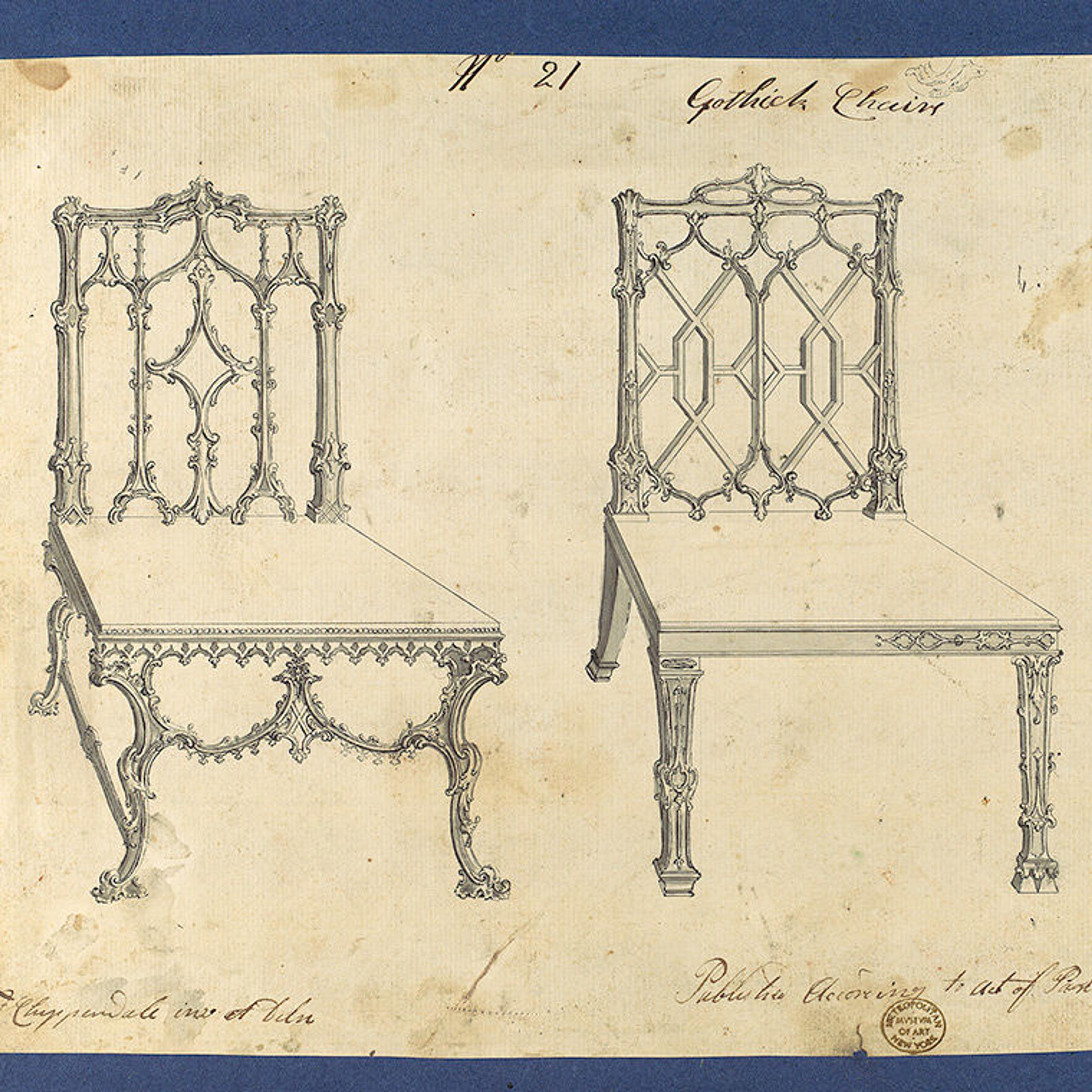
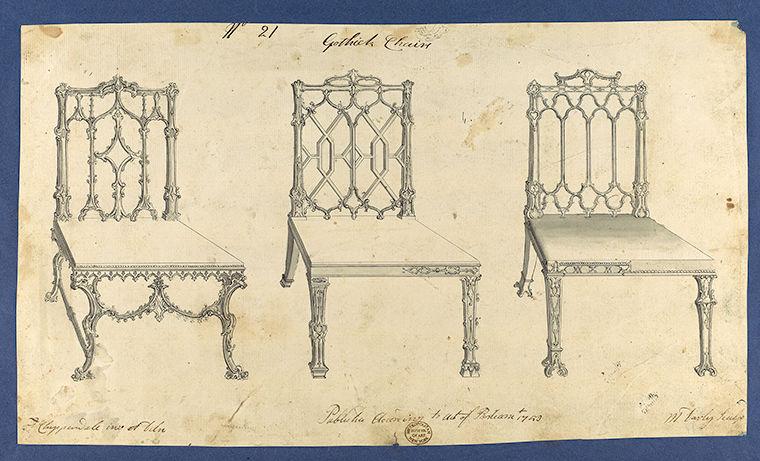
Thomas Chippendale (British, 1718–1779). Gothick [Gothic] Chairs, in Chippendale Drawings, Vol. I, 1753. Black ink, gray ink, and gray wash, 7 13/16 x 13 1/2 in. (19.8 x 34.3 cm). The Metropolitan Museum of Art, New York, Rogers Fund, 1920 (20.40.1[22])
Drawings by the British furniture designer and cabinetmaker Thomas Chippendale (1718–1799)—"that celebrated artist," according to one newspaper of his time—first entered The Met collection in 1920.[1]
That year, William M. Ivins Jr., then a curator in the Museum's newly formed Department of Prints, "first requested an annual appropriation specifically for the purchase of 'ornament,'" as Morrison H. Heckscher, curator emeritus of American art, writes in a new Metropolitan Museum of Art Bulletin essay about Chippendale.[2] By the end of the year, Ivins had acquired 228 drawings by the designer, which the curator described as "extremely rare and important items" and likely worth more than the combined lot of the year's print acquisitions.
The majority of the drawings, Ivins recognized, were the basis of Chippendale's The Gentleman and Cabinet-Maker's Director, which the British artist first published in 1754 to advertise his wares and abilities. The 160 plates in the book outline ideas for chairs, tables, bureaus, and sofas, among other items. The book was a success: 334 copies were sold at the time of publication, launching Chippendale into a steady career.
In a new Timeline of Art History essay, Femke Speelberg, associate curator in the Department of Drawings and Prints, writes: "With the Director, Chippendale presented himself as a highly versatile and skilled furniture designer and maker who was in tune with the interior habits and needs of a wide cross section of modern society, from the country nobleman to the urban 'gentleman' and the newly affluent merchants of the middle classes."
Her essay accompanies the exhibition Chippendale's Director: The Designs and Legacy of a Furniture Maker, which Speelberg co-organized with Alyce Englund, assistant curator in the American Wing.
The entirety of Speelberg's essay, along with more than one thousand others spanning the full range of the Museum's collection, is available on our Heilbrunn Timeline of Art History.
Notes
[1] Morrison H. Heckscher, "Chippendale's Director," The Metropolitan Museum of Art Bulletin 75, no. 4 (Spring 2018): 5.
[2] Ibid., 6.


