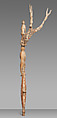
Male ancestor figure
A carver's prestige was second only to that of the most successful warriors, since his activities mirrored those of Fumeripits. Carved images were central to ceremonial life and usually represented recently deceased individuals. The figures served both to commemorate the dead and remind the community that their deaths must be avenged. While the figures depict specific individuals and bear their names, they employ a standardized iconography and are not intended as portraits.
Artwork Details
- Title: Male ancestor figure
- Artist: Asmat artist(s)
- Date: early–mid-20th century
- Geography: Indonesia, West Papua, Munu village, Unir River
- Culture: Asmat people
- Medium: Wood, paint, sago palm leaves, fibers, mulberry fiber, pig tusk, cassowary quills, hair, coix seed
- Dimensions: H. 49 1/2 x W. 16 1/2 x D. 10 1/2 in. (125.7 x 41.9 x 26.7 cm)
- Classification: Wood-Sculpture
- Credit Line: The Michael C. Rockefeller Memorial Collection, Bequest of Nelson A. Rockefeller, 1979
- Object Number: 1979.206.1589
- Curatorial Department: The Michael C. Rockefeller Wing
Audio
1174. Kids: Ancestor Figure, Part 1
Listen to more about this artwork
More Artwork
Press the down key to skip to the last item.
Related Content

Research Resources
The Met provides unparalleled resources for research and welcomes an international community of students and scholars. The Met's Open Access API is where creators and researchers can connect to the The Met collection. Open Access data and public domain images are available for unrestricted commercial and noncommercial use without permission or fee.
To request images under copyright and other restrictions, please use this Image Request form.
Feedback
We continue to research and examine historical and cultural context for objects in The Met collection. If you have comments or questions about this object record, please contact us using the form below. The Museum looks forward to receiving your comments.
Content Notice
The Metropolitan Museum of Art presents over 5,000 years of art from around the world, and our online collection reflects ongoing work conducted over the course of our more than 150-year history. You may encounter objects or images that may be inappropriate for some viewers or information that may be outdated.