Double Eagle Pendant
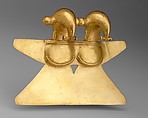
Although single bird pendants are most common, those with two or more birds exist in fair numbers. The twin birds on this pendant have long beaks and share a small bulging body, a pair of talons, wings, and a wide, spread out tail. The symbolic meaning of bird pendants in ancient times is not known in the absence of written records or other sources of information. In the mythology of the present-day Bribri of Costa Rica, the principal deity, called Sibo or Sibu (Creator of all things), takes the form of a kite or buzzard wearing a collar around its neck, as do the birds shown here. Bird pendants may have been intended to provide protection to the wearer. The doubling of the birds could have been meant to increase the protective power of the object.
Artwork Details
- Title: Double Eagle Pendant
- Date: 11th–16th century
- Geography: Panama
- Culture: Veraguas
- Medium: Gold
- Dimensions: H. 5 1/2 x W. 7 3/4 x D. 1 1/2 in. (14 x 19.7 x 3.8cm)
- Classification: Metal-Ornaments
- Credit Line: The Michael C. Rockefeller Memorial Collection, Bequest of Nelson A. Rockefeller, 1979
- Object Number: 1979.206.907
- Curatorial Department: The Michael C. Rockefeller Wing
More Artwork
Press the down key to skip to the last item.
Related Content
 Free to download
Research Resources
The Met provides unparalleled resources for research and welcomes an international community of students and scholars. The Met's Open Access API is where creators and researchers can connect to the The Met collection. Open Access data and public domain images are available for unrestricted commercial and noncommercial use without permission or fee.
To request images under copyright and other restrictions, please use this Image Request form.
Feedback
We continue to research and examine historical and cultural context for objects in The Met collection. If you have comments or questions about this object record, please contact us using the form below. The Museum looks forward to receiving your comments.
Content Notice
The Metropolitan Museum of Art presents over 5,000 years of art from around the world, and our online collection reflects ongoing work conducted over the course of our more than 150-year history. You may encounter objects or images that may be inappropriate for some viewers or information that may be outdated.