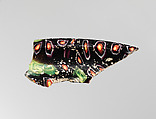
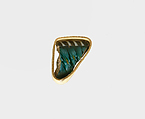
Glass mosaic carinated dish fragment
Translucent deep purple, turquoise blue, partially mixed with yellow and appearing green, opaque white, yellow, and brick red.
Outsplayed, almost horizontal rim with rounded edge; carinated side, with two deep convex curves, the upper one narrow.
Composite mosaic pattern formed from polygonal sections of two canes: one in a purple ground with a circle of white dots and a central white rod encircled by red; the second in a blue ground with a yellow spiral and a central white rod encircled by purple.
Polished interior; pitting and creamy weathering of surface bubbles on interior; dulling, deep pitting, and iridescent weathering on exterior, edge of rim, and jagged side edges; bottom straight edge unweathered.
Artwork Details
- Title: Glass mosaic carinated dish fragment
- Period: Early Imperial
- Date: late 1st century BCE–early 1st century CE
- Culture: Roman
- Medium: Glass; cast
- Dimensions: H.: 3/4 x 1 11/16 in. (2 x 4.2 cm); estimated diam. of rim: 6 5/16 in. (16 cm)
- Classification: Glass
- Credit Line: Edward C. Moore Collection, Bequest of Edward C. Moore, 1891
- Object Number: 91.1.1764
- Curatorial Department: Greek and Roman Art
More Artwork
Press the down key to skip to the last item.
Research Resources
The Met provides unparalleled resources for research and welcomes an international community of students and scholars. The Met's Open Access API is where creators and researchers can connect to the The Met collection. Open Access data and public domain images are available for unrestricted commercial and noncommercial use without permission or fee.
To request images under copyright and other restrictions, please use this Image Request form.
Feedback
We continue to research and examine historical and cultural context for objects in The Met collection. If you have comments or questions about this object record, please contact us using the form below. The Museum looks forward to receiving your comments.
Content Notice
The Metropolitan Museum of Art presents over 5,000 years of art from around the world, and our online collection reflects ongoing work conducted over the course of our more than 150-year history. You may encounter objects or images that may be inappropriate for some viewers or information that may be outdated.