Large Storage Jar (Ōtsubo)
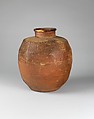
Massive Shigaraki jars—named for the valley of their production—are among the most compelling ceramic works of Japan’s medieval period. This one was constructed in four sections, gradually building up thick coils of clay to form the torso and wide shoulders. The grayish-white material is rich in iron and feldspar, a composition characteristic of Shigaraki and thus imparting a local flavor. In the kiln, it turns a reddish-brown color—this well-fired example shows a warm, deep tone across its unglazed body—while the melting of grains of feldspar speckles the exterior with small white dots that lend texture to the vessel’s powerful form. On the fire-facing side of this jar, a layer of dark-green natural wood ash glaze has formed, including streaks descending from the neck to the base. The “landscape” of the surface is a collaboration among the clay, the wood-fired kiln, and the potter’s hand.
Artwork Details
- 信楽 大壺
- Title: Large Storage Jar (Ōtsubo)
- Period: Muromachi period (1392–1573)
- Date: late 15th century
- Culture: Japan
- Medium: Stoneware with natural ash glaze (Shigaraki ware)
- Dimensions: H. 18 3/8 in. (46.7 cm); Diam. 15 1/2 in. (39.4 cm)
- Classification: Ceramics
- Credit Line: The Harry G. C. Packard Collection of Asian Art, Gift of Harry G. C. Packard, and Purchase, Fletcher, Rogers, Harris Brisbane Dick, and Louis V. Bell Funds, Joseph Pulitzer Bequest, and The Annenberg Fund Inc. Gift, 1975
- Object Number: 1975.268.428
- Curatorial Department: Asian Art
More Artwork
A slider containing 5 items.
Press the down key to skip to the last item.
Press the down key to skip to the last item.
Japanese
16th century
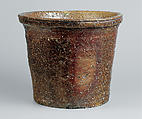
Japan
ca. 16th century
Japan
1680–90s
Armorer Helmet bowl signed Saotome Ietada
Armorer Breastplate inscribed inside, Myōchin Munesuke
16th and 18th centuries
Japan
17th century
Related Content
Research Resources
The Met provides unparalleled resources for research and welcomes an international community of students and scholars. The Met's Open Access API is where creators and researchers can connect to the The Met collection. Open Access data and public domain images are available for unrestricted commercial and noncommercial use without permission or fee.
To request images under copyright and other restrictions, please use this Image Request form.
Feedback
We continue to research and examine historical and cultural context for objects in The Met collection. If you have comments or questions about this object record, please contact us using the form below. The Museum looks forward to receiving your comments.