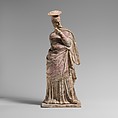
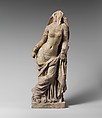
Terracotta statuette of a standing woman
Many of these figurines have been discovered in private dwellings. Like other small-scale sculpture found in houses, they probably had a religious purpose and were placed in domestic shrines. They were also dedicated in sanctuaries and put in tombs. Up to a dozen statuettes were found in some graves at Tanagra. Since fashionable ladies did not usually spend much time outdoors, religious festivals and funeral processions offered the best opportunities for displaying their finery. It is therefore possible that for all their secular appearance, the Tanagras indirectly conveyed to the ancient viewer a reminder of serious ceremonies.
Their relaxed curvaceous poses, sweet faces, and tightly wrapped drapery that forms a complex pattern of fine folds all derive from large-scale sculpture, such as the statues of Praxiteles, the famous Athenian sculptor who was active in the mid-fourth century B.C. The intimate, secular spirit of the Tanagras also reflects contemporary comedies by Athenian playwrights such as Menander, which placed new emphasis on the foibles of everyday life. The figurines still convey a sense of immediacy and liveliness that marks them as true works of art.
Artwork Details
- Title: Terracotta statuette of a standing woman
- Period: Classical
- Date: late 4th–early 3rd century BCE
- Culture: Greek, probably Boeotian
- Medium: Terracotta
- Dimensions: H. 6 7/16 in. (16.4 cm)
- Classification: Terracottas
- Credit Line: Rogers Fund, 1909
- Object Number: 09.221.28
- Curatorial Department: Greek and Roman Art
More Artwork
Press the down key to skip to the last item.
Related Content
Research Resources
The Met provides unparalleled resources for research and welcomes an international community of students and scholars. The Met's Open Access API is where creators and researchers can connect to the The Met collection. Open Access data and public domain images are available for unrestricted commercial and noncommercial use without permission or fee.
To request images under copyright and other restrictions, please use this Image Request form.
Feedback
We continue to research and examine historical and cultural context for objects in The Met collection. If you have comments or questions about this object record, please contact us using the form below. The Museum looks forward to receiving your comments.
Content Notice
The Metropolitan Museum of Art presents over 5,000 years of art from around the world, and our online collection reflects ongoing work conducted over the course of our more than 150-year history. You may encounter objects or images that may be inappropriate for some viewers or information that may be outdated.