Play again
Connections Home
URL
Sign Up
New Connections appear every Wednesday. Sign up for a reminder.
 1280852
 6821024125910243921024804102479310241280745963102410961024128064912809471280996128098391310249131024913102411321024819102489010241280810871102410241024944102410091024875102482810241280960912102412807021280554128033112802131126102412809421280852
I'm Tom Campbell. I'm the director of the Metropolitan Museum, and my topic is "The Edge."
I think often what's going on at the edge of a picture activates it. Sometimes it's easier to come to an object from the outside in
seeing how the artist has played with the edges, or pushed against the edges,
the way the edges record the history of an object
give away the character, the inner soul of an object. It's a kind of a game I play.
So many of the works of art have been removed from their original context. The edges sometimes tell us that story. Our Duccio, its original frame has
on the bottom edge indentations where the frame has been burned by votive candles placed beneath the painting. You think of all of the people who've knelt or
looked carefully at this picture, trying to communicate with something beyond.
The edge of a work of art is a physical reminder of the medium, where you see the grain of the stone from which the sculpture's carved, or
where the staples hold the canvas onto the frame. You're reminded of the moment of genesis, what the artist started from. In this Jackson Pollock, I find my eye follow out the calligraphic wheels of paint. I always think about
how those that stayed on the canvas became part of this iconic painting, while the splatters that fell outside the edge of the canvas remained on the floor.
Edges provoke the history. In this beautiful, half-finished embroidery, made in England in the mid-seventeenth century, the stitching is so minute, the colors are as fresh as the day it was made, and you've still got all of
the ink lines of the pattern that the embroiderer was going to fill in, and yet didn't. And one wonders what happened. Was the maker of this embroidery a victim of the English Civil War? Did they die of the plague? Those edges provoke that question.
Edges are so resonant in terms of the silhouette, the outline
of this Moon jar, where you feel the wetness of the clay
slightly sagging under its own weight.
Or mid-eighteenth-century dresses where the silhouette is outrageous. You think of the guests having to step aside quickly as the lady wearing this ball gown came
barreling through, or no doubt tiptoeing through very daintily.
Very often, it's the edges of a work of art where you find the evidence that's going to help you understand it. In this Petrus Christus painting of a goldsmith and couple buying a wedding ring from him
you've got an inscription giving the name of the artist and the date he made it, but also the bottom edge of the picture is a
trompe l'oeil window shelf, and there's a little mirror balanced on the edge. So you're seeing people who are looking into the window over your shoulder.
Sometimes edges are challenges. The artist had to incorporate decoration within a strange shape of a functional object. You have the calligraphy thrown out against the edge of this bowl, almost like a centrifugal, explosive force driving the letters out from the center, giving a meaning, but also a beautiful pattern.
I love it when an artist makes me think that every square inch of the work is considered. He's been there. The Dance Class: the center of action is, of course, in the middle, where we've got young dancers going through their paces. You can hear the thud of the dancers' feet on the floor. But out on the left hand side, there's a girl, almost out of the frame of the picture,
her back turned to the main action. Degas makes you very conscious of the independent thought of all these different people in the room. He's gone right out to the edges of this canvas.
The soul of a work of art comes through at certain edges. For me, the part that
ignites this sculpture is one of the sleeping boys right up against the edge of the table.
His hand is under his cheek as his hair falls out of the space of the table. The sculptor had to anticipate this gentle, humane gesture and carve that
before he even began to explore the depth of this marble.
Edges take on a different dimension when you get into Chinese paintings. You have these
scrolls, sometimes five, ten, twenty feet long
so there's always this tantalizing sense of what would be seen
beyond the edge if you were to unscroll it further.
It's not always easy to get into a work of art. You have to think your way into it. But I always find that
the edge, the outline, the profile, the exposure of the underlying material helps
ground me as I go about my work.


|
|
|
|
|
|
|
|
|
|
|
|
|
|
Works of art in order of appearanceLast Updated: June 22, 2015. Not all works of art in the Museum's collection may be on view on a particular day. For the most accurate location information, please check this page on the day of your visit. |
||
|
The Conference of the Birds: Page from a manuscript of the Mantiq al-Tayr (The Language of the Birds) of Farid al-Din cAttar ca. 1600; Safavid Iran (Isfahan) Opaque watercolor, ink, silver, gold on paper Fletcher Fund, 1963 (63.210.11) More information: The Collection Online Not on view
|
 Islamic ArtSecond Floor
 |
|
Woods and Valleys of Mount Yu Yuan dynasty, dated 1372 Ni Zan (Chinese) Hanging scroll; ink on paper Inscribed by the artist (upper right) and by the Qianlong emperor Ex coll.: C.C. Wang Family, Gift of the Dillon Fund, 1973 (1973.120.8) More information: The Collection Online Not on view
|
 Asian ArtSecond Floor
 |
|
Madonna and Child ca. 1300 Duccio di Buoninsegna (Italian, Sienese) Tempera and gold on wood, with original engaged frame Purchase, Rogers Fund, Walter and Leonore Annenberg and The Annenberg Foundation Gift, Lila Acheson Wallace Gift, Annette de la Renta Gift, Harris Brisbane Dick, Fletcher, Louis V. Bell, and Dodge Funds, Joseph Pulitzer Bequest, several members of The Chairman's Council Gifts, Elaine L. Rosenberg and Stephenson Family Foundation Gifts, 2003 Benefit Fund, and other gifts and funds from various donors, 2004 (2004.442) More information: The Collection Online Not on view
|
 European PaintingsSecond Floor
 |
|
Fragment of the face of a queen New Kingdom, Amarna Period, Dynasty 18, reign of Akhenaten, ca. 1353–1336 b.c. Egypt, Middle Egypt, el-Amarna (Akhetaten); inc. el-Hagg Qandil Yellow jasper Purchase, Edward S. Harkness Gift, 1926 (26.7.1396) More information: The Collection Online Not on view
|
 Egyptian ArtFirst Floor
 |
|
Autumn Rhythm (Number 30) 1950 Jackson Pollock (American) Enamel on canvas George A. Hearn Fund, 1957 (57.92) © 2011 Pollock-Krasner Foundation/Artists Rights Society (ARS), New York More information: The Collection Online Not on view
|
 Modern and Contemporary ArtSecond Floor
 |
|
David and Abigail mid-17th century English Canvas worked with silk thread; tent, back, and cross stitches; unfinished Gift of Irwin Untermyer, 1964 (64.101.1325) More information: The Collection Online Not on view
|
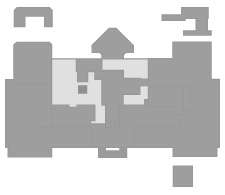 European Sculpture and Decorative ArtsFirst Floor
 |
|
Jar Joseon dynasty, second half of 18th century Korea White porcelain The Harry G. C. Packard Collection of Asian Art, Gift of Harry G. C. Packard, and Purchase, Fletcher, Rogers, Harris Brisbane Dick and Louis V. Bell Funds, Joseph Pulitzer Bequest, and The Annenberg Fund Inc. Gift, 1979 (1979.413.1) More information: The Collection Online Not on view
|
Asian ArtSecond Floor |
|
Court dress ca. 1750 British Blue silk taffeta brocaded with silver thread Purchase, Irene Lewisohn Bequest, 1965 (C.I.65.13.1a–c) More information: The Collection Online Not on view
|
 The Costume InstituteFirst Floor
 |
|
A Goldsmith in His Shop, Possibly Saint Eligius 1449 Petrus Christus (Netherlandish) Oil on wood Robert Lehman Collection, 1975 (1975.1.110) More information: The Collection Online Not on view
|
 The Robert Lehman CollectionFirst Floor
 |
|
Bowl 10th century Samarqand (Uzbekistan) or Nishapur (Iran) Earthenware, red body, white engobe, underglaze-painted Rogers Fund, 1965 (65.106.2) More information: The Collection Online Not on view
|
Islamic ArtSecond Floor |
|
The Dance Class 1874 Edgar Degas (French) Oil on canvas Bequest of Mrs. Harry Payne Bingham, 1986 (1987.47.1) More information: The Collection Online Not on view
|
European PaintingsSecond Floor |
|
La Table aux Amours (The Demidoff Table) 1845 Lorenzo Bartolini (Italian) Marble Gift of Le Duc de Loubat, 1903 (03.11a–d) More information: The Collection Online Not on view
|
European Sculpture and Decorative ArtsFirst Floor |
|
Narcissus Southern Song dynasty (1127–1279) Zhao Mengjian (Chinese) Handscroll; ink on paper Ex coll.: C.C. Wang Family, Gift of The Dillon Fund, 1973 (1973.120.4) More information: The Collection Online Not on view
|
Asian ArtSecond Floor |
|
Burgonet 1543 Made by Filippo Negroli Italian (Milan) Steel, embossed and damascened with gold Gift of J. Pierpont Morgan, 1917 (17.190.1720) More information: The Collection Online Not on view
|
 Arms and ArmorFirst Floor
 |
© 2011 The Metropolitan Museum of Art |
||


