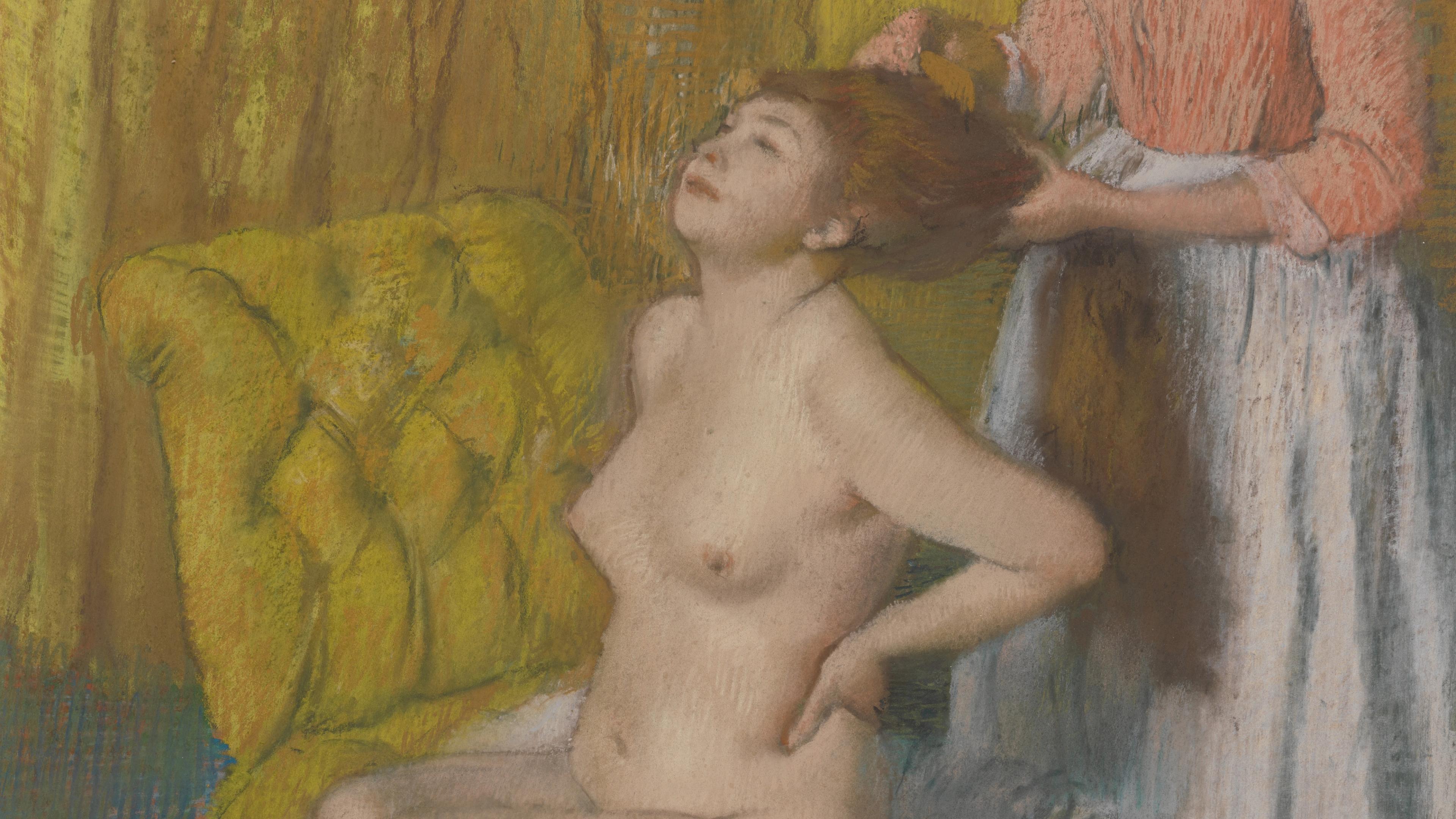
Woman Having Her Hair Combed
Artwork Details
- Title: Woman Having Her Hair Combed
- Artist: Edgar Degas (French, Paris 1834–1917 Paris)
- Date: ca. 1886–88
- Medium: Pastel on light green wove paper, now discolored to warm gray, affixed to original pulpboard mount
- Dimensions: 29 1/8 x 23 7/8 in. (74 x 60.6 cm)
- Classification: Drawings
- Credit Line: H. O. Havemeyer Collection, Bequest of Mrs. H. O. Havemeyer, 1929
- Object Number: 29.100.35
- Curatorial Department: European Paintings
Audio
6224. Woman Having Her Hair Combed
SUSAN STEIN: Degas rendered this nude with countless strokes of pastel, each subtly nuanced to bring the body into relief.
KEITH CHRISTIANSEN: Curator Susan Stein discusses Edgar Degas’s “Woman Having Her Hair Combed:”
SUSAN STEIN: He worked in a gamut of colors, applied in layers, varying the direction of the strokes, as seen especially in the rug with its rose red base and passages of green and turquoise blue. He exploited the full potential of contrast, accentuating her opalescent skin and soft cloud of hair against the acid colors and bolder hatching in the décor. The bather is shown in three-quarter view. She's seated amid drapery and dreamily self-absorbed while being attended to by a servant. Highly finessed, exquisitely worked, this pastel belongs to a series of bathers that Degas intended to exhibit at the 1886 Impressionist Exhibition. He described the group as women bathing, washing themselves, drying themselves, toweling themselves, combing their hair, or having their hair combed. But, curiously, not one reviewer mentioned this pastel. Either Degas did not finish it in time, which is entirely understandable in view of its meticulous technique or he excluded it for some other reason. Perhaps he felt the nude was too refined, too classical in conception, that it lacked the edgier appeal of the other works in the series.
KEITH CHRISTIANSEN: Degas’s nude is entirely unself-conscious, absorbed in her own thoughts. In some ways she recalls—though in a modern, domestic vein—Rembrandt’s moving depiction of the biblical story of Bathsheba at her bath. Degas certainly knew this painting, which is now in the Louvre, for it was owned by a family friend.
More Artwork

Related Content

Research Resources
The Met provides unparalleled resources for research and welcomes an international community of students and scholars. The Met's Open Access API is where creators and researchers can connect to the The Met collection. Open Access data and public domain images are available for unrestricted commercial and noncommercial use without permission or fee.
To request images under copyright and other restrictions, please use this Image Request form.
Feedback
We continue to research and examine historical and cultural context for objects in The Met collection. If you have comments or questions about this object record, please contact us using the form below. The Museum looks forward to receiving your comments.
Content Notice
The Metropolitan Museum of Art presents over 5,000 years of art from around the world, and our online collection reflects ongoing work conducted over the course of our more than 150-year history. You may encounter objects or images that may be inappropriate for some viewers or information that may be outdated.