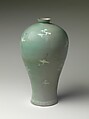
Maebyeong (plum bottle) decorated with cranes and clouds
Artwork Details
- 청자 상감 구름 학 무늬 매병 고려
- 靑磁象嵌雲鶴文梅甁 高麗
- Title: Maebyeong (plum bottle) decorated with cranes and clouds
- Period: Goryeo dynasty (918–1392)
- Date: late 13th century
- Culture: Korea
- Medium: Stoneware with inlaid design under celadon glaze
- Dimensions: H. 11 1/2 in. (29.2 cm); Diam. 7 1/8 in. (18.1 cm); Diam. of base 4 3/8 in. (11.1 cm)
- Classification: Ceramics
- Credit Line: Fletcher Fund, 1927
- Object Number: 27.119.11
- Curatorial Department: Asian Art
Audio
8502. Maebyeong
SOYOUNG LEE: Celadon, or green-glazed ceramics, was first produced in China. It became an important and highly refined art form in Korea under the Koryô dynasty. This graceful jar, known as a Maebyông, was made in the late thirteenth century. The jar is decorated with cranes and clouds, a popular ceramic motif of the time. Notice how the clouds’ elegantly stylised, scrolling forms subtly mirror the cranes’ serpentine lines and outstretched wings. The widely spaced elements give the overall design a light, airy feel, and allow the grayish-green celadon glaze to serve as the sky. The cranes, apart from their decorative qualities, were a symbol for longevity. This maebyông is an excellent example of inlaid celadon, which is considered among the most innovative and elegant of Korean art.Before the glaze was applied to this piece, the cranes and clouds were cut out of the clay in shallow incisions, and filled in with a pale-colored clay mixture. The black lines that define the clouds’ edges and form the cranes’ beaks, eyes and legs, were also inlaid in this way, using a red colored clay mixture. The jar was then covered with celadon glaze and fired, turning the red fillings black.
More Artwork
Press the down key to skip to the last item.
Related Content

Research Resources
The Met provides unparalleled resources for research and welcomes an international community of students and scholars. The Met's Open Access API is where creators and researchers can connect to the The Met collection. Open Access data and public domain images are available for unrestricted commercial and noncommercial use without permission or fee.
To request images under copyright and other restrictions, please use this Image Request form.
Feedback
We continue to research and examine historical and cultural context for objects in The Met collection. If you have comments or questions about this object record, please contact us using the form below. The Museum looks forward to receiving your comments.