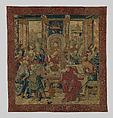
Gluttony from a set of The Seven Deadly Sins
Although it is not known who owned this particular tapestry, many editions of Coecke’s Seven Deadly Sins series were woven in Brussels and were acquired by great collectors like Henry VIII, King of England and Mary of Hungary, Governor of the Habsburg Netherlands. Although the palette remains so strikingly intense, recent technical analysis reveals that the dyes, metal-wrapped threads and weaving technique are all synonymous with mid-sixteenth century production. This border was added during a later, probably nineteenth-century, restoration.
Artwork Details
- Title: Gluttony from a set of The Seven Deadly Sins
- Designer: Pieter Coecke van Aelst (Netherlandish, Aelst 1502–1550 Brussels)
- Date: Between ca. 1550 and 1560
- Culture: Netherlandish, probably Brussels
- Medium: Wool, silk, silver-gilt thread
19-23 warps per inch, 8-10 per cm. - Dimensions: H. 153 x W. 267 inches
388.6 x 678.2 cm - Classification: Textiles-Tapestries
- Credit Line: Gift of Mrs. Frederic R. Coudert Jr., in memory of Mr. and Mrs. Hugh A. Murray, 1957
- Object Number: 57.62
- Curatorial Department: European Sculpture and Decorative Arts
More Artwork
![Le triomphe d'Anvers faict en la susception du Prince Philips, Prince d'Espaign[e], Pieter Coecke van Aelst Netherlandish, Woodcuts](https://images.metmuseum.org/CRDImages/dp/web-additional/DP291970.jpg)
Related Content
 Free to download
Research Resources
The Met provides unparalleled resources for research and welcomes an international community of students and scholars. The Met's Open Access API is where creators and researchers can connect to the The Met collection. Open Access data and public domain images are available for unrestricted commercial and noncommercial use without permission or fee.
To request images under copyright and other restrictions, please use this Image Request form.
Feedback
We continue to research and examine historical and cultural context for objects in The Met collection. If you have comments or questions about this object record, please contact us using the form below. The Museum looks forward to receiving your comments.
Content Notice
The Metropolitan Museum of Art presents over 5,000 years of art from around the world, and our online collection reflects ongoing work conducted over the course of our more than 150-year history. You may encounter objects or images that may be inappropriate for some viewers or information that may be outdated.