Double Virginal
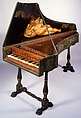
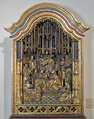
The rectangular shape is typical of Flemish virginals. When not in use, the front panel swings up to conceal the keyboards, and the lid closes to protect the strings. The inner surfaces, revealed when the instrument is opened, are decorated with painted patterns, and the Latin inscription Mvsica Dvlce Laborvm Levamen (Sweet music is a balm for toil) hangs from the instrument like a banner. The jackrail of the smaller keyboard is signed "HANS RVEKERS ME FECIT" and the initials "HR" appear to the left of the larger keyboard. Over the larger keyboard two gilded medallions, profile portraits of Philip II of Spain and his wife Anne of Austria, face each other.
The inside lid reveals a beautiful painted interior with a pleasure garden scene, the maker of which is unknown. The theme of the outdoor garden party, the buitenpartij or fête champêtre, of which this is an early example, became a popular genre in the seventeenth-century Netherlands, reviving the age-old artistic tradition of the Garden of Love. Although somewhat stiffly executed, stylistically this painted view on the virginal fits garden scenes made by contemporary Flemish Renaissance artists, including Lodewijk Toeput (1550–ca. 1605) and David Vinckboons (1576–1629). Particularly charming in this garden scene is the way in which the elegantly dressed members of the upper class are amusing themselves in the meadows of the adjoining, moated castle. Their activities range from dining and playing musical instruments in the central pergola, to gentle promenades, embarking on a boat ride, or playing the game of kolf, forerunner of today's golf. The text painted on the dropboard of this virginal, Musica Dulce Laborum ("sweet music eases work"), not only refers to the playing of this keyboard instrument, but also to the musicians in the painted garden of leisure.
The royal family may have commissioned this instrument to send to friends or emissaries in the New World, as it was found in Cuzco, Peru, in a hacienda chapel early in the twentieth century. Although it is not known who owned or played this instrument, keyboards often were associated with women musicians.
Artwork Details
- Title: Double Virginal
- Maker: Hans Ruckers the Elder (Flemish, Mechelen ca. 1545–1598 Antwerp)
- Date: 1581
- Geography: Antwerp, Flemish
- Culture: Flemish
- Medium: Pine, beech, poplar, mahogany, paint, gesso, metal, parchment, brass
- Dimensions: Width: 71 3/4 in. (182.2 cm)
Depth: 19 1/2 in. (49.5 cm) - Classifications: Chordophone-Zither-plucked-virginal, Paintings
- Credit Line: Gift of B. H. Homan, 1929
- Object Number: 29.90
- Curatorial Department: Musical Instruments
More Artwork
Press the down key to skip to the last item.
Related Content
Research Resources
The Met provides unparalleled resources for research and welcomes an international community of students and scholars. The Met's Open Access API is where creators and researchers can connect to the The Met collection. Open Access data and public domain images are available for unrestricted commercial and noncommercial use without permission or fee.
To request images under copyright and other restrictions, please use this Image Request form.
Feedback
We continue to research and examine historical and cultural context for objects in The Met collection. If you have comments or questions about this object record, please contact us using the form below. The Museum looks forward to receiving your comments.
Content Notice
The Metropolitan Museum of Art presents over 5,000 years of art from around the world, and our online collection reflects ongoing work conducted over the course of our more than 150-year history. You may encounter objects or images that may be inappropriate for some viewers or information that may be outdated.