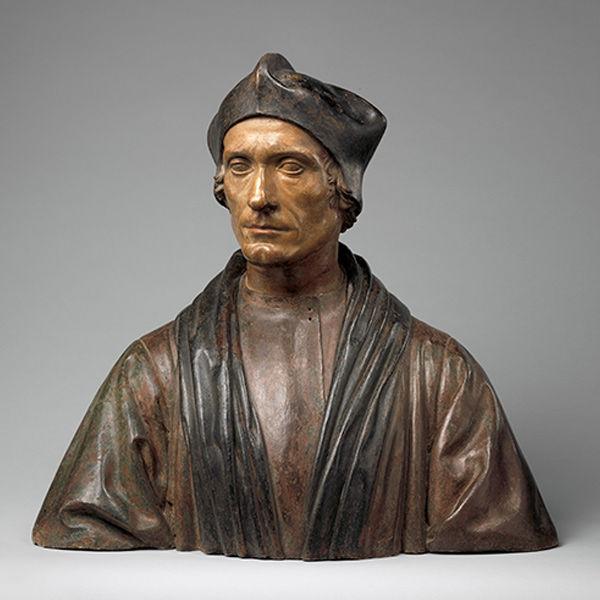
Portrait Bust of John Fisher, Bishop of Rochester
Artwork Details
- Title: Portrait Bust of John Fisher, Bishop of Rochester
- Artist: Pietro Torrigiano (Italian, Florence 1472–1528 Seville)
- Date: 1510–15
- Culture: British
- Medium: Polychrome terracotta
- Dimensions: Overall (confirmed): 24 1/4 × 25 7/8 × 13 3/8 in., 62 lb. (61.6 × 65.7 × 34 cm, 28.1 kg)
- Classification: Sculpture
- Credit Line: Harris Brisbane Dick Fund, 1936
- Object Number: 36.69
- Curatorial Department: European Sculpture and Decorative Arts
Audio
401. The Sixteenth Century
Gallery 509
NARRATOR: You’re looking at a terracotta bust of Bishop John Fisher–more about his dramatic story in a moment). The sculptor, Pietro Torregiano was Italian, and studied alongside Michelangelo in Florence. King Henry VIII probably invited Torregiano to England, where he joined many émigré artists–all enriching the nation's melting pot of style and skill. In the sixteenth century, London had both wealth and a unique perspective on classical tradition: a win-win for the arts. The Met's Curator of British Decorative Arts, Wolf Burchard:
WOLF BURCHARD: It's a really extraordinary work of art: an object that epitomizes the very complex relationship between insular Britain and continental Europe.
NARRATOR: Torregiano was, shall we say, motivated to leave Florence, having broken Michelangelo’s nose in a “disagreement.” (Italy’s loss, England’s gain.)
WOLF BURCHARD: I think that tension between the fragility of the highly delicate object and the brutality of the man is rather interesting.
NARRATOR: But who was Bishop Fisher, and what does he have to do with the history of decorative arts in Britain? Consider it’s 1533, and King Henry VIII has called Parliament into session.
Against the dictates of the powerful Roman Catholic Church, the king wants the unthinkable: a divorce from the Queen. Why? She's accused of being unable to produce an heir. Bishop Fisher opposes the King and his supporters.:
BISHOP JOHN FISHER: Blessed Jesus, what sort of conscience do these “learned fellows” have, who so grievously mutilate and distort the sayings of so weighty an author in a matter of such importance, They do not seem to care how narrowly they restrict papal authority as long as they can secure the divorce.
NARRATOR: In breach of the Roman Catholic Church, Henry VIII overrides Bishop Fisher’s position and creates a new Church of England. It’s a monumental turning point in the history of Britain and its relationship with mainland Europe. And what did it mean for art? Look around you: Since the royals ordained destruction of Catholic artwork, suddenly a new generation of artisans could craft suitable replacements.
NARRATOR: On the left wall, the elaborately carved oak paneling you see is an example of home-grown Tudor craftsmanship. Although many luxurious objects at the time were imported to England from Europe, this paneling was actually produced in the Northeast county of Norfolk. Look closely and you'll see carved caryatids, pilasters, and Corinthian capitals. These draw heavily on styles popularized in the Netherlands, which, in turn, drew heavily from the classical architecture of ancient Rome.
More Artwork
Related Content
Research Resources
The Met provides unparalleled resources for research and welcomes an international community of students and scholars. The Met's Open Access API is where creators and researchers can connect to the The Met collection. Open Access data and public domain images are available for unrestricted commercial and noncommercial use without permission or fee.
To request images under copyright and other restrictions, please use this Image Request form.
Feedback
We continue to research and examine historical and cultural context for objects in The Met collection. If you have comments or questions about this object record, please contact us using the form below. The Museum looks forward to receiving your comments.
Content Notice
The Metropolitan Museum of Art presents over 5,000 years of art from around the world, and our online collection reflects ongoing work conducted over the course of our more than 150-year history. You may encounter objects or images that may be inappropriate for some viewers or information that may be outdated.